

Buyer Not Liable for Seller’s Tax Default: Supreme Court’s Landmark Principle on Input Tax Credit
Introduction
Input Tax Credit (ITC) is the backbone of every value-added indirect tax system. Whether under the earlier Value Added Tax (VAT) laws or the present Goods and Services Tax (GST) regime, ITC ensures that tax is levied only on value addition and not on the entire transaction value.
However, for years, taxpayers have faced a serious and recurring problem — denial of ITC due to the seller’s failure to deposit tax with the Government, despite the buyer having acted honestly and complied with all legal requirements.
This controversy reached the Supreme Court in the landmark case of
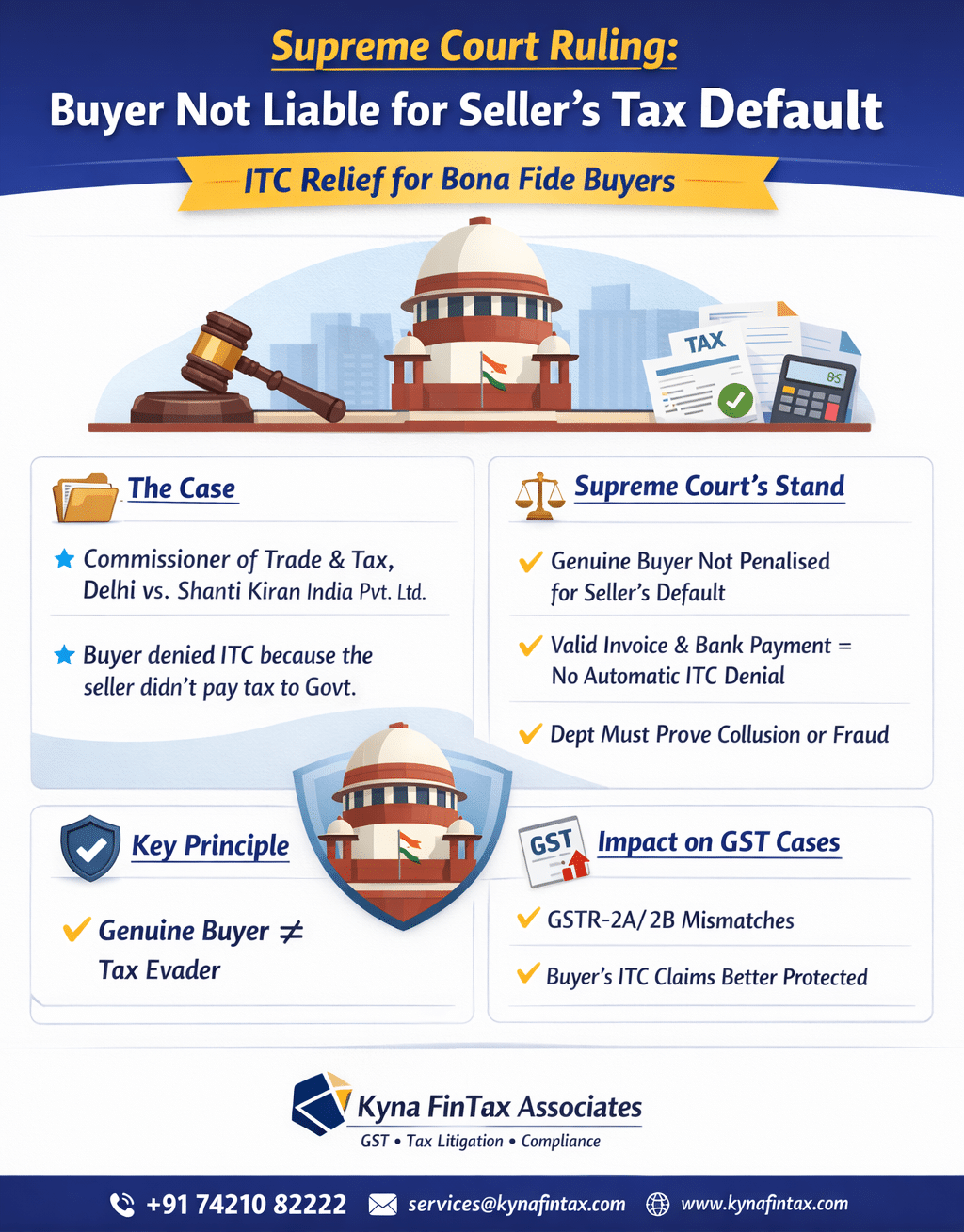
Commissioner, Trade & Taxes, Delhi vs. Shanti Kiran India Pvt. Ltd.
The ruling laid down a foundational legal principle:
A bona fide purchasing dealer cannot be punished for the default of the selling dealer, unless collusion or fraud is established.
Although the case arose under the Delhi VAT Act, its reasoning continues to play a crucial role in GST-era ITC litigation, especially in cases involving supplier defaults, non-filing of returns, or GSTR-2A/2B mismatches.
Background of the Case
M/s Shanti Kiran India Pvt. Ltd. was a registered dealer under the Delhi Value Added Tax Act, 2004. The company claimed Input Tax Credit on purchases made from registered selling dealers.
The factual position was clear and undisputed:
- Purchases were genuine
- Sellers were registered dealers
- Valid tax invoices were issued
- Payments, including VAT, were made through banking channels
- Goods were actually received and used in business
Despite this, the Department denied ITC on the sole ground that the selling dealers failed to deposit the tax collected into the Government treasury.
The Assessing Authority relied on Section 9(2)(g) of the DVAT Act, which restricted ITC where tax was not “actually paid” to the Government.
The Core Legal Issue
The central question before the courts was simple but far-reaching:
Can Input Tax Credit be denied to a purchasing dealer merely because the selling dealer failed to deposit tax with the Government, even when the buyer has paid tax, possesses valid invoices, and the transaction is genuine?
Department’s Traditional Stand: Why Buyers Were Penalised
Historically, tax departments across states followed a strict approach:
- VAT and GST are invoice-based systems
- If tax does not reach the Government, revenue leakage occurs
- Denying ITC to buyers was considered an enforcement tool
Authorities argued that:
- ITC is a concession, not an absolute right
- Buyer must ensure the seller’s compliance
- Supplier default breaks the tax chain
This approach led to:
- Mechanical ITC reversals
- Huge interest (18%) and penalties
- Severe cash-flow stress for MSMEs
- Endless litigation
Delhi High Court’s Progressive Interpretation
The Delhi High Court rejected the Department’s rigid stance.
The Court held that:
- A buyer cannot be expected to police the seller
- Once the buyer has:
- Paid tax
- Received goods
- Obtained valid invoices
the buyer’s statutory obligation ends
The High Court ruled that:
The Department’s remedy lies against the defaulting seller, not against an innocent buyer.
Section 9(2)(g) was read in a manner consistent with fairness, proportionality, and natural justice.
Supreme Court’s Analysis
When the matter reached the Supreme Court, the Court adopted a balanced and legally sound approach.
Key Observations
- Protection of Bona Fide Buyers
Tax laws are meant to punish evaders, not honest taxpayers. - No Automatic ITC Denial
Seller default alone cannot justify ITC denial. - Verification Is Permissible
Authorities are entitled to verify:- Genuineness of transactions
- Movement of goods
- Payment trails
- Burden of Proof Lies on the Department
Unless collusion, fraud, or sham transactions are established, ITC cannot be denied.
Supreme Court’s Final Direction
Instead of granting blanket relief, the Supreme Court remanded the matter to the Assessing Authority with clear guidance:
- Verify whether:
- Purchases are genuine
- Payments are through banking channels
- Valid tax invoices exist
- If no evidence of collusion or fake transactions is found:
ITC must be allowed
This approach protects revenue without sacrificing justice.
Legal Principle Established
The ruling firmly establishes:
Seller’s default ≠ Buyer’s offence
A purchasing dealer cannot be treated as a defaulter if:
- Transactions are genuine
- Documentation is proper
- Payments are traceable
- There is no collusion
Relevance Under the GST Regime
Although delivered under DVAT, the principle has strong persuasive value under GST, especially in disputes involving:
- GSTR-2A / 2B mismatches
- Supplier non-filing of returns
- Supplier tax defaults
- Section 16(2)(c) disputes
Courts increasingly hold that:
- ITC cannot be denied mechanically
- Buyer’s conduct matters
- Fraud must be proved, not presumed
Buyer Benefits: Pre vs Post Judgment
| Aspect | Earlier Position | After Shanti Kiran Principle |
|---|---|---|
| ITC denial | Automatic | Fact-based |
| Burden of proof | On buyer | On Department |
| Seller default | Buyer punished | Seller targeted |
| Litigation success | Low | High (if genuine) |
| MSME impact | Severe | Substantially reduced |
Practical Checklist for Buyers
To defend ITC claims effectively:
- Verify supplier GST registration at purchase time
- Pay through banking channels only
- Retain:
- Tax invoices
- E-way bills
- Goods receipt notes
- Bank statements
- Maintain records for at least 72 months
- Respond to SCNs with documentary proof and judicial support
The Supreme Court, through Shanti Kiran India Pvt. Ltd., reaffirmed a core principle of tax justice:
Honest buyers should not suffer for another person’s default.
While the law allows scrutiny, it does not permit harassment.
While revenue must be protected, fairness cannot be sacrificed.
For genuine businesses, this judgment remains a powerful shield against arbitrary ITC denial — under both VAT and GST.
Kyna FinTax LLP
Kyna FinTax LLP is a Delhi-based professional firm specialising in GST litigation, ITC disputes, tax notices, ROC compliances, and indirect tax advisory.
Contact Details
Kyna FinTax LLP
WZ-1390/Z2, 3rd Floor, Nangal Raya Extension
South West Delhi – 110046
📞 +91 74210 82222
📧 services@kynafintax.com
🌐 https://kynafintax.com