
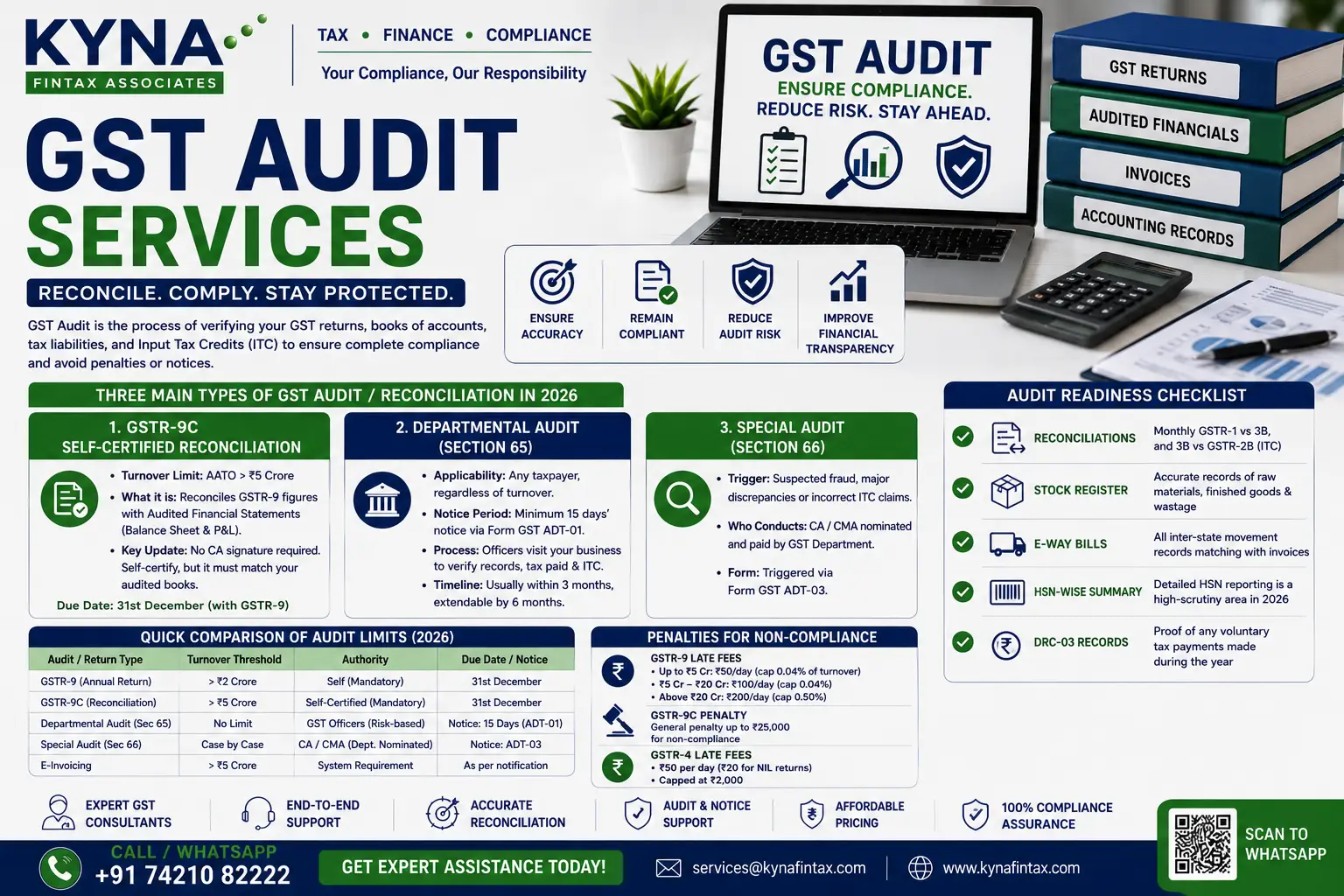
GST Audit Services in Delhi
Looking for reliable GST Audit Services in Delhi? Kyna FinTax LLP provides professional GST audit support, GST reconciliation, GST annual compliance, departmental audit assistance, GSTR-9C reconciliation, ITC verification, and GST scrutiny support services for proprietorship firms, partnership firms, LLPs, private limited companies, traders, manufacturers, wholesalers, retailers, service providers, startups, and e-commerce businesses across Delhi and India.
As per the latest GST compliance framework in 2026, the concept of GST Audit has evolved from mandatory CA-certified audits to a system of:
- self-certified reconciliation
- departmental audit scrutiny
- risk-based GST verification
- compliance reconciliation
Proper GST audit preparation helps businesses:
- maintain GST compliance
- reduce GST notices
- verify Input Tax Credit (ITC)
- reconcile GST returns with books
- avoid departmental disputes
- improve financial transparency
- reduce audit risk
We provide GST audit services across:
- Dwarka
- Janakpuri
- Uttam Nagar
- Palam
- Tilak Nagar
- Hari Nagar
- Rajouri Garden
- Subhash Nagar
- Mayapuri
- Naraina
- Kirti Nagar
- Rohini
- NSP
- Pitampura
- Punjabi Bagh
- Paschim Vihar
- Patel Nagar
- Karol Bagh
- Connaught Place
- Laxmi Nagar
- Shahdara
- Preet Vihar
- Okhla
- Bawana
- Narela
- West Delhi
- South Delhi
- North Delhi
- South West Delhi
If you are searching for:
- GST audit services
- GST audit consultant in Delhi
- GST reconciliation services
- GSTR-9C filing services
- GST departmental audit support
- GST scrutiny support
- GST compliance audit
- GST consultant near me
Kyna FinTax LLP provides complete professional assistance.
What is GST Audit?
GST Audit is the process of verifying:
- GST returns
- books of accounts
- tax liability
- Input Tax Credit (ITC)
- turnover reporting
- GST compliance records
The purpose of GST audit is to ensure that the information reported in GST returns properly matches the accounting records and financial statements of the business.
Under the latest GST framework, GST audits may generally include:
- GSTR-9C reconciliation
- departmental audit
- special audit
- GST scrutiny proceedings
Latest GST Audit Updates in 2026
The earlier mandatory GST audit certification by Chartered Accountant (CA) or Cost Accountant (CMA) under Section 35(5) has generally been removed from FY 2020-21 onwards.
It has now largely been replaced by:
- self-certified GSTR-9C reconciliation
- departmental scrutiny
- GST risk-based verification
Businesses are still required to maintain proper:
- GST records
- reconciliations
- accounting books
- tax compliance documentation
for annual GST compliance and audit readiness.
Types of GST Audit in India
GSTR-9C Self-Certified Reconciliation
GSTR-9C is one of the most important annual GST reconciliation statements for eligible taxpayers.
GSTR-9C Applicability
GSTR-9C may generally be mandatory for taxpayers having:
Aggregate Annual Turnover (AATO) Above ₹5 Crore
under applicable GST provisions.
Purpose of GSTR-9C
GSTR-9C helps reconcile:
- GSTR-9 Annual Return
- audited financial statements
- balance sheet
- profit & loss account
- GST turnover
- Input Tax Credit (ITC)
Self-Certification in GSTR-9C
Eligible taxpayers may generally self-certify GSTR-9C. CA or CMA certification is no longer mandatory under applicable GST provisions.
However, the reconciliation statement should properly match:
- audited books
- GST returns
- annual turnover
- tax liability
Departmental GST Audit Under Section 65
Departmental audit is generally conducted by GST officers or authorized departmental authorities.
Applicability of Departmental Audit
Departmental audit may generally be conducted for:
Any Taxpayer
regardless of turnover.
GST Audit Notice
The department generally issues:
Form GST ADT-01
before initiating departmental audit proceedings.
Notice Period
The taxpayer may generally receive:
Minimum 15 Days Notice
before audit commencement.
Departmental GST Audit Process
During the audit process, GST officers may verify:
- GST returns
- books of accounts
- invoices
- stock records
- Input Tax Credit
- tax payments
- e-way bills
- reconciliation statements
GST Audit Timeline
Departmental audits are generally completed within:
3 Months
though the period may generally be extended in complex cases under applicable provisions.
Special Audit Under Section 66
Special Audit is generally initiated when the GST department suspects:
- major discrepancies
- incorrect tax liability
- excess ITC claims
- complex transactions
- fraud risk
Trigger for Special Audit
Special audit may generally be initiated if the GST department believes:
- tax liability was not properly declared
- ITC was wrongly availed
- records require detailed investigation
Who Conducts Special Audit?
Special audit is generally conducted by:
- Chartered Accountant (CA)
- Cost Accountant (CMA)
nominated by the GST department.
GST Special Audit Form
Special audit proceedings may generally be initiated through:
Form GST ADT-03
under applicable GST provisions.
GST Audit Turnover Limits & Applicability
GSTR-9 Annual Return
Generally applicable for taxpayers having:
Aggregate Annual Turnover Above ₹2 Crore
under applicable GST provisions.
GSTR-9C Reconciliation
Generally applicable for taxpayers having:
Aggregate Annual Turnover Above ₹5 Crore
under applicable GST provisions.
Departmental GST Audit
Departmental audits may generally apply:
Without Any Turnover Limit
based on departmental risk assessment or scrutiny selection.
E-Invoicing Applicability
E-invoicing compliance may generally apply for eligible businesses crossing prescribed turnover thresholds under applicable GST notifications.
GST Audit Readiness Checklist
Businesses should maintain proper GST compliance records to remain audit-ready.
Monthly GST Reconciliation
Businesses should reconcile:
- GSTR-1 vs GSTR-3B
- GSTR-3B vs GSTR-2B
- books of accounts vs GST returns
regularly.
Maintain Proper Stock Register
Businesses should maintain:
- raw material records
- finished goods records
- wastage records
- inventory movement records
properly.
Verify E-Way Bills
Businesses should ensure:
- e-way bills match invoices
- transport records are accurate
- inter-state movement is properly documented
Maintain HSN-Wise Summary
HSN-wise reporting is one of the most scrutinized compliance areas under GST.
Businesses should maintain:
- accurate HSN classification
- proper tax rate mapping
- outward supply summary
Maintain DRC-03 Records
Businesses should preserve records of:
- voluntary tax payments
- additional tax liability payments
- DRC-03 challans
- GST compliance corrections
Common GST Audit Issues
Incorrect GST compliance may lead to:
- GST notices
- audit observations
- ITC mismatch
- turnover mismatch
- departmental scrutiny
- tax demand notices
Common GST Audit Errors
- incorrect ITC claims
- mismatch between GSTR-1 & GSTR-3B
- turnover reconciliation mismatch
- incorrect HSN reporting
- missing invoices
- stock discrepancy
- e-way bill mismatch
- incorrect tax liability reporting
Documents Required for GST Audit
Common Documents Required
- GST Login Credentials
- GSTR-1 Returns
- GSTR-3B Returns
- GSTR-9 & GSTR-9C
- Sales Register
- Purchase Register
- Stock Register
- E-Way Bills
- Audited Financial Statements
- Balance Sheet
- Profit & Loss Account
- Trial Balance
- GST Reconciliation Reports
- DRC-03 Payment Records
Benefits of Professional GST Audit Services
Professional GST audit assistance helps businesses:
- maintain GST compliance
- reduce mismatch risk
- improve ITC accuracy
- prepare for departmental scrutiny
- avoid penalties and notices
- maintain proper audit documentation
- improve financial transparency
Why Choose Kyna FinTax LLP?
Kyna FinTax LLP provides professional GST audit services in Delhi with complete GST reconciliation and compliance support.
Our Strengths
- Experienced GST Consultants
- GST Audit Expertise
- GST Reconciliation Support
- Annual Compliance Assistance
- Fast Documentation Support
- Affordable Pricing
- WhatsApp Assistance
- Delhi-Based Professional Team
Frequently Asked Questions (FAQs)
Is CA certification mandatory for GST Audit?
Mandatory CA-certified GST audit under Section 35(5) has generally been removed. Eligible taxpayers may generally self-certify GSTR-9C under applicable provisions.
What is the turnover limit for GSTR-9C?
GSTR-9C may generally apply to taxpayers having aggregate annual turnover above ₹5 crore.
Can the GST department audit any taxpayer?
Yes, departmental GST audit may generally be conducted for any taxpayer based on departmental selection or risk assessment.
What is Form GST ADT-01?
Form GST ADT-01 is generally used for issuing departmental GST audit notices.
Why is GST reconciliation important?
Proper reconciliation helps reduce:
- ITC mismatch
- turnover mismatch
- GST notices
- audit risk
- compliance issues
Related Services
- GSTR-9 Filing Services
- GSTR-9C Filing Services
- GST Reconciliation Services
- GST Notice Support
- GST Annual Return Filing
- GST Consultancy Services
Get Professional GST Audit Support in Delhi
Looking for reliable GST audit services in Delhi? Contact Kyna FinTax LLP for professional GST reconciliation, audit preparation, departmental audit support, and GST compliance services.
Kyna FinTax LLP
WZ-1390/Z2, 3rd Floor, Nangal Raya Extension, South West Delhi – 110046
Phone / WhatsApp: +91 74210 82222
Email: services@kynafintax.com
Website: https://kynafintax.com
For GST registration and return updates, visit GST Portal.