
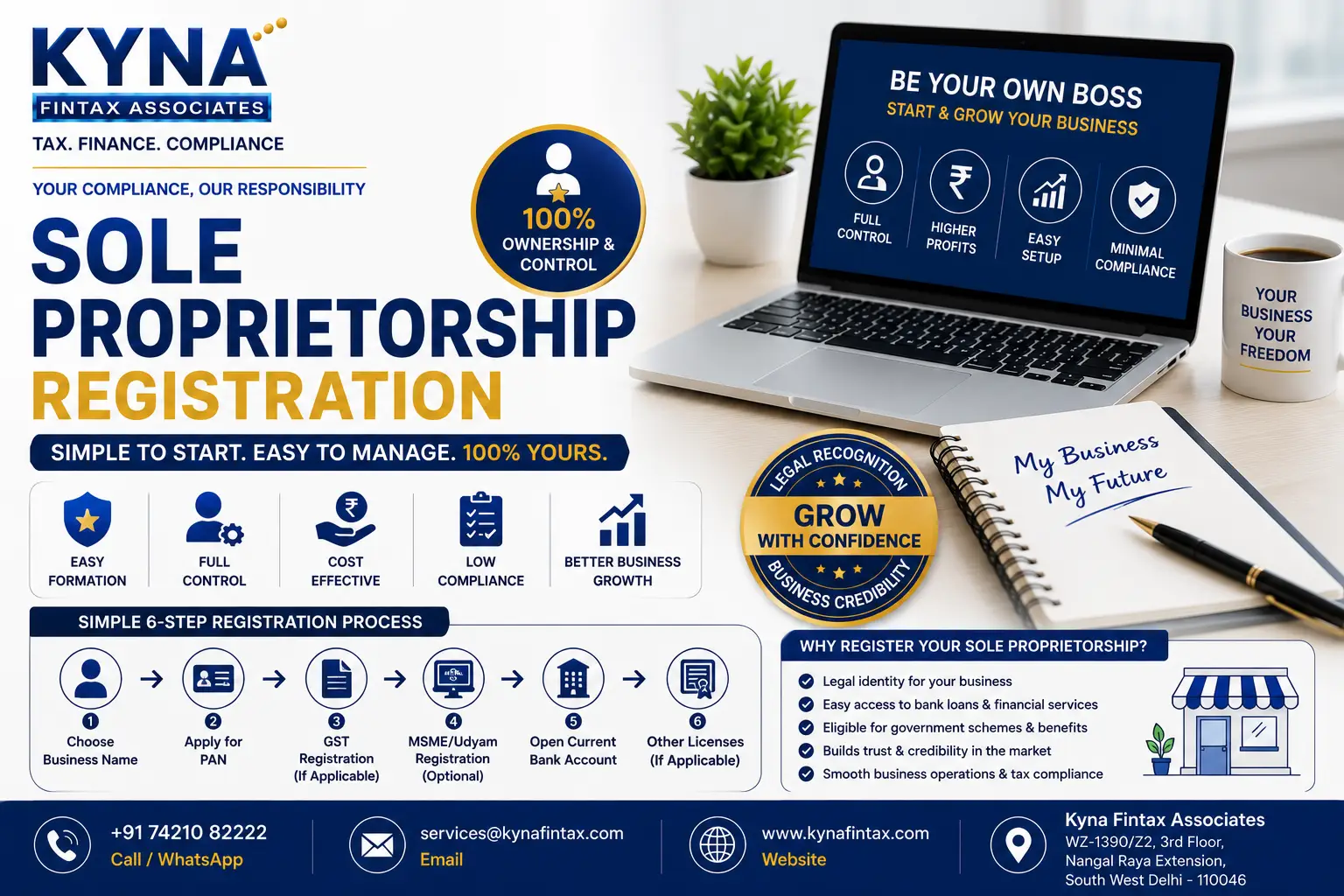
Sole Proprietorship Registration in India – Complete Process, Documents, Fees & Compliance Guide
A Sole Proprietorship Registration is one of the easiest and most commonly chosen business structures in India. It is ideal for small business owners, freelancers, consultants, local traders, shop owners, and service providers who want complete control over their business with minimal legal formalities.
A Sole Proprietorship is owned and managed by a single individual, making it one of the simplest forms of business to start and operate. Although there is no separate legal registration specifically for a proprietorship firm under Indian law, the business can establish legal identity through registrations like GST, MSME, Shop & Establishment License, and current bank account documentation.
This detailed guide explains the complete process of Sole Proprietorship Registration in India, including required documents, registration procedure, benefits, compliance requirements, GST registration, and important legal considerations.
What is a Sole Proprietorship?
A Sole Proprietorship is a business structure owned and operated by a single individual. The owner and the business are legally treated as the same entity.
The proprietor has complete authority over business operations, profits, decision-making, and management.
This business structure is widely preferred due to:
- Easy setup process
- Minimal compliance
- Low operational cost
- Full ownership control
Features of Sole Proprietorship Registration
Single Ownership
Only one person owns and manages the business.
Complete Business Control
The proprietor has full authority over operations and decision-making.
Easy Formation
The business can be started quickly with basic registrations.
Minimal Compliance
Compliance requirements are comparatively lower than companies and LLPs.
Low Setup Cost
Registration and maintenance costs are affordable.
Direct Taxation
Business income is taxed in the hands of the proprietor as individual income.
Eligibility Criteria for Sole Proprietorship Registration
There are no strict eligibility conditions for starting a Sole Proprietorship in India.
However, the proprietor must have:
- Valid PAN Card
- Aadhaar Card
- Business Address Proof
- Bank Account
- Applicable business registrations
There is no minimum capital requirement for starting a proprietorship business.
Documents Required for Sole Proprietorship Registration
Documents of Proprietor
PAN Card
PAN Card of the proprietor is mandatory.
Aadhaar Card
Aadhaar Card is commonly used as identity and address proof.
Identity Proof
Any one of the following may be required:
- Aadhaar Card
- Passport
- Voter ID
- Driving License
Address Proof
Recent address proof documents include:
- Electricity Bill
- Bank Statement
- Mobile Bill
- Telephone Bill
Business Address Proof
The business must provide address proof for registration purposes.
Required documents include:
- Electricity Bill or Utility Bill
- Rent Agreement (if rented)
- No Objection Certificate (NOC)
- Property Tax Receipt (if applicable)
How to Register a Sole Proprietorship in India?
There is no separate central registration process for Sole Proprietorship under the Companies Act. Generally, proprietorship businesses establish legal identity through various registrations.
Step 1 – Choose Business Name
Select a suitable business name for your proprietorship firm.
The name should:
- Be unique
- Not violate trademarks
- Match your business activity
Step 2 – Apply for PAN Card (if not available)
The proprietor must have a valid PAN Card.
Business income will be filed under the proprietor’s individual PAN.
Step 3 – Open Current Bank Account
To open a current account in the business name, banks generally require:
- GST Registration
- MSME Registration
- Shop & Establishment License
- Business proof documents
Step 4 – Obtain GST Registration (if applicable)
GST registration becomes mandatory if:
- Turnover exceeds prescribed limits
- Interstate supply is involved
- Business operates through e-commerce platforms
GST registration also acts as business identity proof.
Step 5 – MSME/Udyam Registration
MSME (Udyam) Registration helps proprietorship businesses avail:
- Government schemes
- Subsidies
- Bank loan benefits
- MSME protection benefits
Step 6 – Shop & Establishment Registration
Depending on state laws, businesses may require Shop & Establishment License for legal operations.
GST Registration for Sole Proprietorship
GST Registration is one of the most commonly used registrations for Sole Proprietorship businesses.
Benefits include:
- Legal business identity
- Input tax credit benefits
- Easy bank account opening
- Better business credibility
- Compliance with tax laws
Advantages of Sole Proprietorship Registration
Easy to Start
Very few formalities are required to start operations.
Full Business Control
The proprietor has complete authority over decisions and profits.
Low Compliance Burden
Annual compliances are minimal compared to companies and LLPs.
Affordable Setup
The business can be started with low investment.
Easy Tax Filing
Income is reported in the proprietor’s individual Income Tax Return.
Suitable for Small Businesses
Ideal for startups, traders, consultants, freelancers, and local businesses.
Disadvantages of Sole Proprietorship
Unlimited Liability
The proprietor is personally liable for all business liabilities and debts.
No Separate Legal Identity
The business and proprietor are legally the same entity.
Limited Funding Opportunities
External investors generally do not invest in proprietorship businesses.
Business Continuity Risk
Business continuity may be affected in the absence of the proprietor.
Sole Proprietorship vs OPC
| Basis | Sole Proprietorship | OPC |
|---|---|---|
| Legal Identity | No Separate Identity | Separate Legal Entity |
| Liability | Unlimited | Limited |
| Compliance | Very Low | Moderate |
| Ownership | Single Owner | Single Owner |
| Funding Scope | Limited | Better |
| Registration | Informal | MCA Registration Required |
Who Should Choose Sole Proprietorship?
Sole Proprietorship is suitable for:
- Freelancers
- Consultants
- Small Traders
- Retail Shop Owners
- Local Businesses
- Online Sellers
- Service Providers
- Home-Based Businesses
Common Mistakes During Sole Proprietorship Registration
Not Obtaining GST Registration
Businesses often ignore GST registration despite applicability.
Mixing Personal & Business Finances
Separate business banking is important for proper accounting.
Ignoring Trademark Search
Using a conflicting business name may create legal issues later.
Non-Compliance with Local Laws
Some businesses require municipal or state-level licenses.
Why Professional Assistance is Important?
Professional consultants help with:
- GST Registration
- MSME Registration
- Business documentation
- Tax compliance
- Current account opening support
- Legal advisory
Professional guidance ensures smoother setup and compliance management.
Sole Proprietorship Registration Fees in India
The registration cost depends on:
- GST Registration
- MSME Registration
- Shop License Fees
- Professional Charges
- State-specific business licenses
The total setup cost is generally much lower than LLPs and companies.
A Sole Proprietorship Registration is one of the best options for individuals planning to start a small business with complete ownership and minimal compliance burden.
With advantages like easy setup, low operational cost, direct control, and simplified taxation, proprietorship firms remain one of the most practical business structures in India.
Entrepreneurs seeking quick and affordable business setup can strongly consider starting a Sole Proprietorship.
Frequently Asked Questions (FAQs)
Is Sole Proprietorship Registration mandatory?
There is no separate mandatory registration under central law, but businesses generally obtain GST, MSME, or local licenses for legal identity.
Can a Sole Proprietorship get GST Registration?
Yes, Sole Proprietorship businesses can obtain GST Registration.
Is there any minimum capital requirement?
No, there is no minimum capital requirement.
Can a salaried person start a Sole Proprietorship?
Yes, subject to employment agreement conditions.
Is audit mandatory for Sole Proprietorship?
Tax audit applicability depends on turnover and Income Tax provisions.
How long does Sole Proprietorship Registration take?
Generally, the process takes around 2–7 working days depending on registrations involved.
Can a proprietorship convert into Private Limited Company or LLP later?
Yes, business conversion is possible as the business grows.
Kyna FinTax LLP
Kyna FinTax LLP provides professional assistance for Sole Proprietorship Registration, GST registration, MSME/Udyam registration, taxation, startup advisory, business compliance, and legal documentation services across India.
Contact Details:
Kyna FinTax LLP
WZ-1390/Z2, 3rd Floor, Nangal Raya Extension, South West Delhi – 110046
📞 WhatsApp/Call: +91 74210 82222
📧 services@kynafintax.com
🌐 https://kynafintax.com
For GST registration and return updates, visit GST Portal.