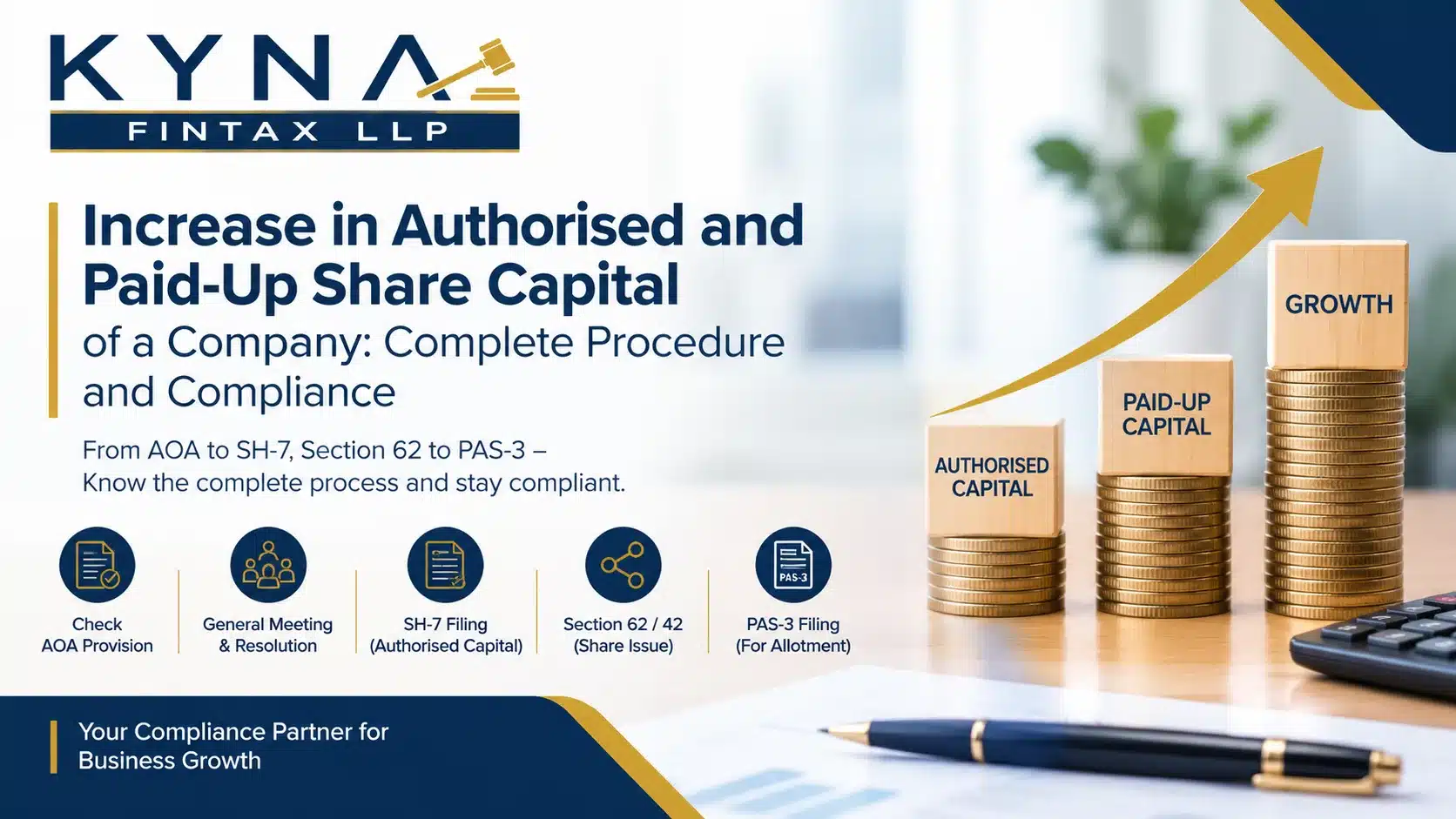
A company may need to increase its share capital for several reasons, including raising additional funds, bringing in new investors, issuing shares to existing shareholders, expanding business operations, restructuring the shareholding pattern, or meeting future funding requirements.
However, increase in authorised share capital and increase in paid-up share capital are two different corporate actions.
A company may first need to increase its authorised share capital to create sufficient capacity for issuing additional shares. It can then issue and allot new shares in accordance with the applicable provisions of the Companies Act, 2013.
The compliance requirements depend upon the nature and method of the proposed issue. Important provisions that may become relevant include:
- Section 14 – Alteration of Articles of Association
- Section 61 – Alteration of share capital
- Section 62 – Further issue of share capital
- Section 42 – Private placement
- Section 64 – Notice of alteration of share capital
- Applicable rules under the Companies Act, 2013
- Form SH-7 – Notice of alteration of share capital
- Form PAS-3 – Return of allotment
This article explains the complete practical process for increasing both authorised share capital and paid-up share capital of a company.
1. What is Authorised Share Capital?
Authorised share capital is the maximum amount of share capital that a company is authorised to issue as specified in its constitutional documents.
For example, suppose a company has:
Authorised Share Capital: ₹10,00,000
Paid-Up Share Capital: ₹5,00,000
If the company wants to issue additional shares that would take its capital beyond the existing authorised limit, it will generally need to increase its authorised share capital before making the proposed allotment.
Under Section 61 of the Companies Act, 2013, a limited company having share capital may increase its authorised share capital if it is authorised by its Articles of Association and the required corporate procedure is followed.
2. What is Paid-Up Share Capital?
Paid-up share capital represents the amount of share capital that has been paid or credited as paid-up on the shares issued and allotted by the company.
For example:
- Authorised Capital: ₹50,00,000
- Issued Capital: ₹30,00,000
- Subscribed Capital: ₹30,00,000
- Paid-Up Capital: ₹30,00,000
The company may therefore have a large authorised capital without immediately having the same amount as paid-up capital.
This leads to an important distinction:
Increasing authorised capital does not automatically increase paid-up capital.
Paid-up capital generally increases when the company actually issues and allots additional shares and the relevant amount becomes paid-up.
3. Difference Between Authorised Capital and Paid-Up Capital
| Particular | Authorised Share Capital | Paid-Up Share Capital |
|---|---|---|
| Meaning | Maximum capital the company is authorised to issue | Amount paid/credited as paid-up on allotted shares |
| Main provision | Section 61 | Depends upon the relevant issue/allotment provisions |
| Relevant ROC form | SH-7 for alteration | PAS-3 after allotment |
| Actual allotment required? | No | Yes, for an increase through fresh issue |
| Can exist without the other increasing? | Yes | Paid-up must remain within the authorised framework |
| Example | ₹50 lakh | ₹30 lakh |
Understanding this distinction is essential before starting the compliance process.
4. Step 1 – Check the Articles of Association
The first step should be to review the company’s Articles of Association (AOA).
Section 61 specifically provides that a limited company having share capital may alter its share capital if it is authorised by its Articles.
Therefore, before proceeding with the increase in authorised share capital, check whether the AOA contains an enabling provision.
If the AOA contains the required provision
The company can proceed with the authorised capital alteration in accordance with the applicable provisions.
If the AOA does not contain the required provision
The Articles may first need to be altered under Section 14, subject to the applicable requirements.
The company should therefore not directly proceed to SH-7 without first checking the AOA.
5. Step 2 – Decide the Proposed Capital Structure
Before passing the resolution, the company should determine its proposed capital structure.
For example:
Existing Capital
- Authorised Share Capital: ₹10,00,000
- Paid-Up Share Capital: ₹5,00,000
Proposed Capital
- Authorised Share Capital: ₹50,00,000
- Paid-Up Share Capital: ₹30,00,000
In this example, the company first needs to create sufficient authorised capital and then undertake the appropriate fresh issue and allotment process to increase its paid-up capital.
It is also important to determine:
- Number of shares
- Face value per share
- Class of shares
- Number of new shares proposed to be issued
- Issue price
- Premium, if any
- Proposed subscribers/allottees
- Method of issue
6. Step 3 – Board Meeting
The company should initiate the process through the appropriate Board-level approvals.
Depending upon the transaction, the Board may consider and approve matters such as:
- Proposal for increase in authorised share capital
- Proposed alteration of AOA, if required
- Calling of General Meeting
- Draft notice of General Meeting
- Proposed resolution
- Proposed fresh issue of shares, if being considered simultaneously
- Issue price and other terms, where applicable
- Authorisation of officers/professionals for ROC filings
The exact resolutions will depend upon the company’s proposed transaction.
7. Step 4 – General Meeting and Resolution
The company must obtain the required shareholder approval for the proposed alteration in accordance with the applicable provisions.
Section 61 allows a company, if authorised by its Articles, to alter its share capital in a general meeting by increasing its authorised share capital by such amount as it considers appropriate.
The resolution should clearly specify the proposed increase.
Example
Existing authorised capital:
₹10,00,000 divided into 1,00,000 equity shares of ₹10 each
Proposed authorised capital:
₹50,00,000 divided into 5,00,000 equity shares of ₹10 each
The resolution should clearly provide for the proposed alteration.
8. Step 5 – Alteration of AOA, Where Required
If the Articles of Association do not contain the necessary enabling provision, the company may need to alter its AOA before or as part of the authorised capital alteration process.
Section 14 deals with alteration of Articles of Association.
The company should therefore examine:
- Existing AOA
- Existing authorised capital clause/provision
- Enabling provisions relating to share capital
- Required shareholder approval
- ROC filing requirements
The exact documentation should be prepared according to the company’s existing Articles and proposed transaction.
9. Step 6 – MGT-14, Where Applicable
A common misconception is that MGT-14 is automatically required for every increase in authorised share capital.
The requirement should instead be determined based on the nature of the resolution passed, the applicable provisions and whether the company is required to file that resolution with the Registrar.
Therefore, before filing MGT-14, the company should identify:
- Whether a Special Resolution has been passed
- Which provision requires filing
- Whether any exemption applies to the particular company
- Whether the resolution is required to be filed with the ROC
Where MGT-14 is applicable, it should be filed within the prescribed statutory timeline.
10. Step 7 – File Form SH-7
Once the authorised share capital has been validly altered, the company is required to comply with the applicable filing requirements under Section 64.
Form SH-7 is used for reporting alteration of share capital to the Registrar of Companies.
The form generally captures details such as:
- CIN
- Existing authorised capital
- Revised authorised capital
- Type of alteration
- Class of shares
- Number of shares
- Face value
- Resolution details
- Applicable fees
- Stamp duty, wherever applicable
The company should ensure that the information in SH-7 is consistent with the resolution, Memorandum/Articles and the company’s existing MCA records.
11. What Happens After SH-7?
This is where the distinction between authorised and paid-up capital becomes very important.
Suppose the company had:
Before SH-7
- Authorised Capital = ₹10 lakh
- Paid-Up Capital = ₹5 lakh
After successfully completing the authorised capital alteration:
After SH-7
- Authorised Capital = ₹50 lakh
- Paid-Up Capital = ₹5 lakh
The paid-up capital has not automatically increased.
The company has simply increased the maximum capital it is authorised to issue.
The next step is the actual issue and allotment of shares.
12. Step 8 – Decide the Method of Fresh Issue
Once sufficient authorised capital is available, the company needs to determine how the new shares will be issued.
The applicable compliance depends upon the nature of the issue.
Common routes include:
- Rights Issue
- Preferential Issue
- Private Placement
- ESOP
- Bonus Issue
- Other permitted methods
The relevant provisions should be identified before proceeding with the transaction.
13. Rights Issue Under Section 62(1)(a)
Where a company proposes to issue further equity shares to its existing equity shareholders in proportion to their existing shareholding, the rights issue provisions under Section 62(1)(a) may apply.
Section 62 provides that where a company proposes to increase its subscribed capital by issuing further shares, the shares are generally offered to existing equity shareholders in proportion to their paid-up share capital, subject to the conditions prescribed under the Act.
The broad process may include:
1. Board Approval
The Board approves the proposed rights issue.
2. Rights Offer
The company makes the offer to the existing shareholders in accordance with Section 62 and applicable rules.
3. Subscription
Shareholders accept the offer and pay the required amount.
4. Allotment
The Board approves the allotment after completion of the applicable process.
5. PAS-3
The company files the applicable return of allotment with the ROC.
6. Statutory Records
The company updates its Register of Members and other applicable records.
14. Issue of Shares to Selected Persons
If the company proposes to issue shares to selected persons instead of following a normal rights issue, different provisions may apply.
Depending upon the structure, Section 62(1)(c) and the applicable rules may become relevant.
Where the transaction is structured as a private placement, the requirements of Section 42 and the applicable provisions of the Companies (Prospectus and Allotment of Securities) Rules, 2014 also need to be examined.
Therefore, the company should first determine the exact nature of the proposed issue before preparing the resolutions and documentation.
15. Private Placement Under Section 42
Private placement is a regulated method of raising funds from identified persons.
Where Section 42 applies, the company needs to comply with the statutory requirements relating to private placement.
Depending upon the transaction, the compliance may involve:
- Identification of proposed investors
- Required Board approval
- Shareholder approval, where applicable
- Private placement offer documentation
- PAS-4 and related documentation, where applicable
- Maintenance of records
- Receipt of subscription money in the prescribed manner
- Allotment within the applicable statutory framework
- PAS-3
- Other applicable disclosures and filings
Private placement should therefore not be treated as merely a matter of collecting money and subsequently filing PAS-3.
The underlying issue must itself comply with the applicable provisions.
16. Step 9 – Allotment of Shares
After completing the applicable issue process and receiving subscription money in accordance with the relevant route, the company proceeds with the allotment of shares.
The Board should pass the appropriate allotment resolution.
The allotment documentation should correctly record:
- Name of allottee
- Number of shares allotted
- Face value
- Premium, if any
- Total consideration
- Amount paid-up
- Date of allotment
- Other prescribed particulars
17. Step 10 – File PAS-3
After allotment, the company is required to file the Return of Allotment in Form PAS-3 with the Registrar.
MCA’s PAS-3 instructions provide that the return of allotment is to be filed after allotment of shares/securities. The current MCA instructions prescribe within 30 days of allotment for general allotments, while private-placement allotments have a 15-day filing timeline.
Therefore, the applicable PAS-3 timeline should be determined from the nature of the allotment.
PAS-3 generally contains information relating to:
- Date of allotment
- Class of securities
- Number of securities
- Nominal value
- Amount paid on securities
- Details of allottees
- Consideration received
- Other prescribed information
MCA’s PAS-3 instructions also provide for details of allottees and securities allotted.
18. Step 11 – Update Statutory Records
After allotment, the company should update its internal statutory records.
This may include:
- Register of Members
- Shareholding records
- Share certificate records
- Capital structure
- Minutes and Board records
- Accounting records
- Beneficial ownership records, where applicable
- Other statutory registers and records
The company’s books and MCA records should also be reconciled.
19. Complete Compliance Sequence
For a company intending to increase both authorised and paid-up share capital, the broad sequence can be represented as follows:
Stage 1 – Increase in Authorised Capital
AOA Review
↓
AOA alteration under Section 14, if required
↓
Board Meeting
↓
General Meeting / Required Shareholder Approval
↓
Resolution for increase in authorised capital
↓
MGT-14, where applicable
↓
SH-7 filing
↓
Authorised Capital Increased
Stage 2 – Increase in Paid-Up Capital
Determine Issue Route
↓
Section 62 / Section 42 / Other Applicable Provisions
↓
Required Board & Shareholder Approvals
↓
Issue of Shares
↓
Receipt of Subscription Money
↓
Allotment of Shares
↓
PAS-3 Filing
↓
Update Register of Members & Other Records
↓
Paid-Up Capital Increased
20. Example – Authorised Capital ₹10 Lakh to ₹50 Lakh and Paid-Up Capital ₹5 Lakh to ₹30 Lakh
Consider the following example.
Existing Capital
- Authorised Capital: ₹10,00,000
- Paid-Up Capital: ₹5,00,000
Proposed Capital
- Authorised Capital: ₹50,00,000
- Paid-Up Capital: ₹30,00,000
The company wants to issue additional shares worth ₹25,00,000.
Phase 1 – Authorised Capital
The company first checks its AOA.
If the AOA permits the increase, the company follows the applicable corporate approval process and files SH-7.
After completion:
Authorised Capital = ₹50,00,000
However:
Paid-Up Capital = ₹5,00,000
There is no automatic increase in paid-up capital merely because SH-7 has been filed.
Phase 2 – Fresh Issue
The company then decides the appropriate method of issuing the additional ₹25,00,000 capital.
Depending upon the circumstances, the issue may be structured as a rights issue, preferential issue, private placement or another legally permitted route.
After completing the applicable issue and allotment process:
Paid-Up Capital = ₹30,00,000
The company then completes the applicable PAS-3 filing and updates its statutory records.
21. Important Compliance Documents
For Increase in Authorised Share Capital
Depending upon the transaction, the following may be required:
- Board Resolution
- General Meeting Notice
- Explanatory Statement, where applicable
- Shareholders’ Resolution
- Altered AOA, where applicable
- MGT-14, where applicable
- Form SH-7
- Applicable ROC fees
- Applicable stamp duty
- Updated corporate records
For Increase in Paid-Up Share Capital
Depending upon the issue route:
- Board Resolution
- Shareholders’ Resolution, where applicable
- Rights offer documents, where applicable
- Private placement documentation, where applicable
- PAS-4, where applicable
- Relevant valuation/report, where applicable
- List of allottees
- PAS-3
- Share certificates
- Register of Members
- Other statutory records
The exact documents should be determined based on the nature of the proposed issue.
22. Common Mistakes While Increasing Share Capital
Mistake 1 – Assuming SH-7 increases paid-up capital
It does not.
SH-7 relates to alteration of share capital, particularly authorised capital in the usual capital-increase scenario.
Paid-up capital increases after the company actually issues and allots shares.
Mistake 2 – Ignoring the AOA
Section 61 requires the company to be authorised by its Articles for the relevant alteration.
Therefore, AOA review should be one of the first steps.
Mistake 3 – Issuing shares beyond the authorised capital
The company should ensure that sufficient authorised capital is available before making an allotment that would take the issued/subscribed capital beyond the authorised limit.
Mistake 4 – Treating all fresh issues in the same manner
A rights issue, preferential issue, private placement, ESOP and bonus issue are not identical transactions.
The applicable provisions and compliance requirements can differ significantly.
Mistake 5 – Accepting private placement money without following the applicable process
Private placement is regulated under Section 42 and the applicable rules.
The company should structure the transaction correctly before receiving subscription money.
Mistake 6 – Filing PAS-3 without completing the underlying allotment compliance
PAS-3 is a return of allotment.
It does not replace the corporate approvals and substantive compliance required for the issue itself.
Mistake 7 – Missing ROC filing timelines
SH-7, MGT-14, PAS-3 and other applicable forms have specific statutory filing requirements.
Delayed filing can result in additional fees and/or penalties.
The applicable timeline should therefore be checked for each form based on the transaction date and nature of the filing.
23. Authorised Capital vs Paid-Up Capital – Key Takeaway
The easiest way to understand the process is:
Authorised Capital
How much capital is the company authorised to issue?
Paid-Up Capital
How much capital has actually been issued/allotted and paid or credited as paid-up?
Therefore:
Increasing authorised capital creates additional capacity to issue shares.
And:
Issuing and allotting additional shares is what increases paid-up capital through a fresh issue.
24. Professional Compliance Checklist
Before completing the transaction, the company should verify the following:
- AOA reviewed
- Enabling provision checked
- AOA alteration completed, if required
- Proposed capital structure finalised
- Board approval completed
- General Meeting approval completed, where required
- Correct resolution passed
- MGT-14 filed, where applicable
- SH-7 filed within the applicable timeline
- Revised authorised capital reflected in MCA records
- Correct route for fresh issue identified
- Section 62 compliance checked
- Section 42 compliance checked, where applicable
- Applicable Rules checked
- Required shareholder approval obtained
- Subscription money received in accordance with applicable provisions
- Shares validly allotted
- PAS-3 filed within the applicable timeline
- Register of Members updated
- Share certificates/documentation completed
- Accounting records updated
- Statutory records updated
- MCA records reconciled
Increasing the authorised and paid-up share capital of a company involves two separate but connected compliance stages.
Stage 1 – Increase Authorised Share Capital
AOA Review → Required Corporate Approval → MGT-14, Where Applicable → SH-7 → Revised Authorised Capital
Stage 2 – Increase Paid-Up Share Capital
Select Appropriate Issue Route → Section 62 / Section 42 / Applicable Rules → Required Approvals → Issue & Allotment → PAS-3 → Statutory Record Updates
The most important point to remember is that filing SH-7 does not by itself increase the paid-up share capital. SH-7 deals with the alteration of the company’s authorised share capital, whereas the paid-up capital increases when additional shares are validly issued and allotted.
The exact compliance depends upon the company’s Articles of Association, existing capital structure, type of company, proposed subscribers, issue price, mode of issue and whether the transaction is structured as a rights issue, preferential issue, private placement or another permitted form of issue.
Therefore, before accepting subscription money or proceeding with allotment, the company should identify the correct statutory route and complete the applicable corporate and ROC compliances.
Professional Note: This article is for general informational purposes and should not be treated as a substitute for transaction-specific professional advice. Companies should verify the latest Companies Act provisions, rules, MCA forms, notifications, exemptions, filing fees, statutory timelines and MCA portal requirements applicable on the date of filing.
Frequently Asked Questions (FAQs)
1. Can a company increase authorised capital without increasing paid-up capital?
Yes. A company can increase its authorised share capital without immediately increasing its paid-up share capital. Paid-up capital increases when additional shares are actually issued and allotted.
2. Which form is used to increase authorised share capital?
Form SH-7 is used for the applicable notice of alteration of share capital to the Registrar.
3. Which form is used after allotment of new shares?
Form PAS-3 is generally used for filing the return of allotment with the ROC.
4. Is SH-7 enough to increase paid-up capital?
No. SH-7 does not itself constitute an allotment of shares. A valid issue and allotment process must be completed separately.
5. Is MGT-14 mandatory for every authorised capital increase?
Not necessarily. The requirement should be determined based on the nature of the resolution, applicable provision and whether the company is required to file that resolution with the ROC. Any applicable exemption should also be considered.
6. Can a company directly issue shares if its authorised capital is insufficient?
The company should first ensure that sufficient authorised capital is available for the proposed issue. An allotment should not result in the company’s issued/subscribed capital exceeding its authorised capital.
7. Does Section 62 apply to every fresh issue?
Section 62 deals with further issue of share capital, but the exact compliance depends upon the nature and route of the issue. Rights issue, preferential issue, private placement and other forms of issue may have different requirements.
8. Does Section 42 apply to every issue of shares?
No. Section 42 primarily deals with private placement. Whether it applies depends upon how the proposed issue is structured.
9. How long does the complete process take?
The timeline depends upon the type of company, AOA position, required shareholder approvals, issue route, valuation requirements, subscription process and MCA filing timelines. Therefore, there is no single universal timeline for every capital increase.
10. Can the authorised and paid-up capital be increased together?
Yes, they can form part of the same overall business plan, but the authorised capital alteration and actual share allotment are legally distinct steps and the applicable compliance for each stage must be completed.
Need Professional Assistance for Increasing Share Capital?
Increasing the authorised and paid-up share capital of a company involves multiple corporate approvals, statutory forms and ROC compliances. The correct procedure depends on the company’s AOA, proposed capital structure and the method of issue of shares.
KYNA FINTAX LLP can assist your company with the complete process, including:
- AOA review and compliance advisory
- Increase in authorised share capital
- Board and shareholder resolutions
- MGT-14, where applicable
- SH-7 filing
- Rights / preferential / private placement issue compliance
- Section 62 and Section 42 compliance, where applicable
- Share allotment documentation
- PAS-3 filing
- Complete ROC compliance and documentation
Get in Touch With KYNA FINTAX LLP
📞 Call: 7421082222
📧 Email: services@kynafintax.com
For quick assistance, you can contact us directly:
KYNA FINTAX LLP – Your Compliance Partner for Business Growth