
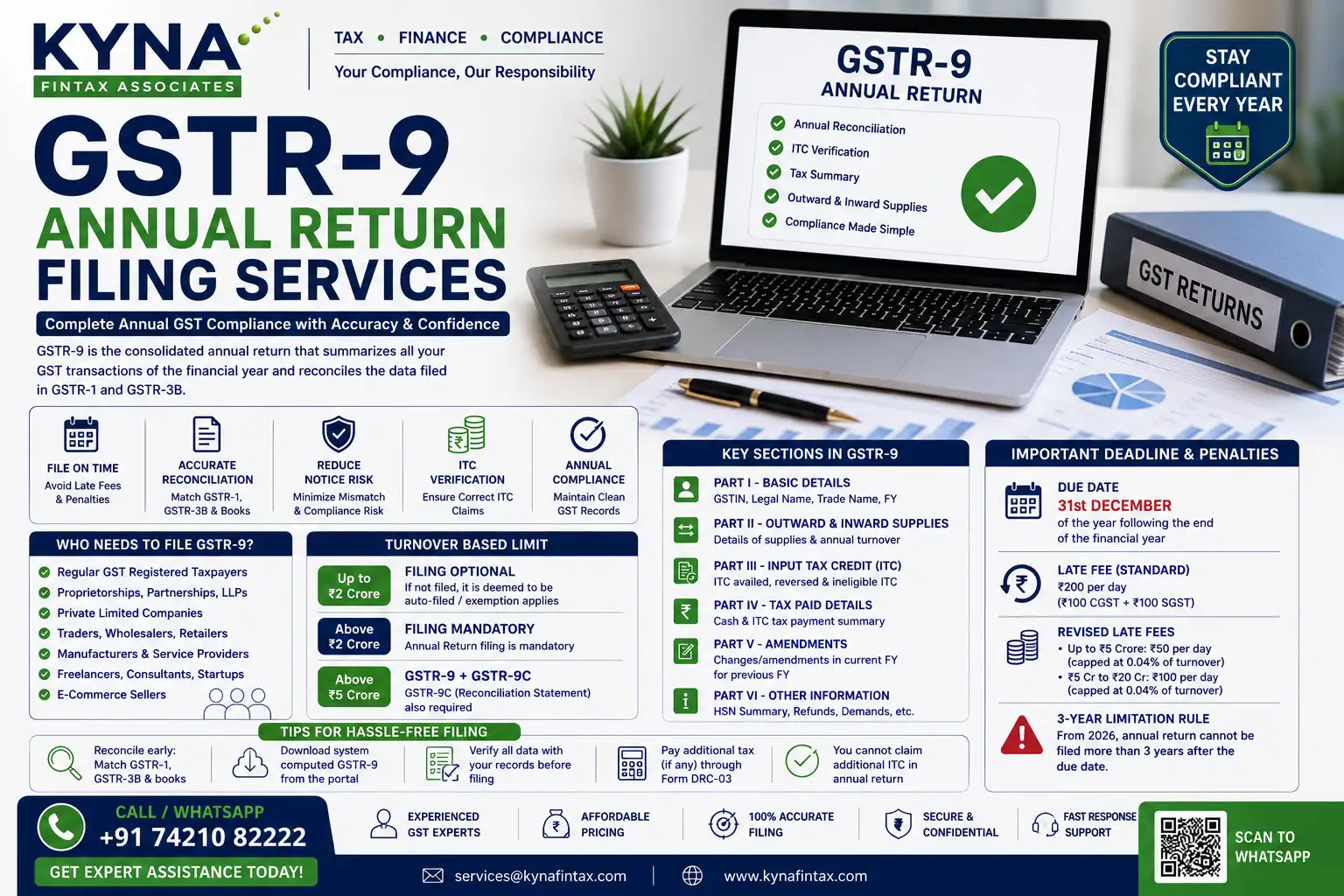
GSTR-9 Annual Return Filing Services in Delhi
Looking for reliable GSTR-9 Annual Return Filing Services in Delhi? Kyna FinTax LLP provides professional GSTR-9 filing, annual GST reconciliation, ITC verification, GST compliance review, and GST annual return support for proprietorship firms, partnership firms, LLPs, private limited companies, traders, manufacturers, freelancers, consultants, service providers, startups, and e-commerce sellers across Delhi and India.
GSTR-9 is one of the most important annual GST compliance returns for regular taxpayers. It acts as a consolidated annual summary of all GST returns filed during the financial year, including GSTR-1 and GSTR-3B. Proper and timely GSTR-9 filing helps businesses maintain GST compliance, avoid notices and penalties, reduce reconciliation mismatch issues, and maintain accurate annual GST records.
We provide GSTR-9 filing services across:
- Dwarka
- Janakpuri
- Uttam Nagar
- Palam
- Tilak Nagar
- Hari Nagar
- Rajouri Garden
- Subhash Nagar
- Mayapuri
- Naraina
- Kirti Nagar
- Rohini
- NSP
- Pitampura
- Paschim Vihar
- Punjabi Bagh
- Patel Nagar
- Karol Bagh
- Connaught Place
- Laxmi Nagar
- Shahdara
- Preet Vihar
- Okhla
- Bawana
- Narela
- West Delhi
- South Delhi
- North Delhi
- South West Delhi
If you are searching for:
- GSTR-9 filing services
- annual GST return filing
- online GSTR-9 filing
- GSTR-9 consultant in Delhi
- GST annual return filing near me
- GST annual compliance services
- GST reconciliation services
- GSTR-9 filing for companies
- GSTR-9 filing for traders
Kyna FinTax LLP provides complete professional assistance.
What is GSTR-9?
GSTR-9 is the consolidated annual GST return generally filed by eligible regular taxpayers once every financial year under applicable GST provisions.
It acts as the final annual reconciliation of:
- GSTR-1 returns
- GSTR-3B returns
- Input Tax Credit (ITC)
- annual turnover
- GST liability
- tax payments
- books of accounts
GSTR-9 helps the GST department verify yearly GST compliance and reconcile the data filed in monthly or quarterly GST returns.
Why is GSTR-9 Annual Return Filed?
GSTR-9 Annual Return is generally filed to:
- reconcile annual GST data
- verify yearly tax liability
- match GSTR-1 with GSTR-3B
- verify Input Tax Credit claims
- identify GST mismatches
- maintain annual GST compliance
- provide annual turnover reporting
- reduce GST notice risk
- maintain proper financial transparency
Proper annual GST reconciliation helps businesses avoid future GST disputes and compliance issues.
GSTR-9 Filing Applicability & Turnover Limit
The requirement to file GSTR-9 generally depends on Aggregate Annual Turnover (AATO).
Turnover Up to ₹2 Crore
For eligible taxpayers with aggregate annual turnover up to ₹2 crore, GSTR-9 filing has generally been optional in various financial years as per applicable GST notifications.
Turnover Above ₹2 Crore
Businesses with aggregate annual turnover above ₹2 crore may generally be required to file GSTR-9 under applicable GST provisions.
Turnover Above ₹5 Crore
Businesses with aggregate annual turnover above ₹5 crore may generally also require:
- GSTR-9 filing
- GSTR-9C filing
- annual reconciliation statement compliance
under applicable GST provisions.
Who Should File GSTR-9?
GSTR-9 may generally apply to:
- proprietorship businesses
- partnership firms
- LLPs
- private limited companies
- traders
- wholesalers
- retailers
- manufacturers
- service providers
- freelancers
- startups
- e-commerce sellers
Who is Generally Exempt from GSTR-9?
Applicability and exemptions may vary depending on:
- turnover
- taxpayer category
- GST registration type
- applicable GST notifications
Businesses should review applicable GST provisions carefully before filing.
Key Information & Sections in GSTR-9
GSTR-9 generally contains multiple sections covering yearly GST information.
Part I – Basic Details
This section generally includes:
- GSTIN
- legal name
- trade name
- financial year
Part II – Outward & Inward Supplies
This section generally covers:
- taxable outward supplies
- exempt supplies
- inward supplies
- annual turnover details
Part III – Input Tax Credit (ITC)
This section generally includes:
- ITC availed
- ITC reversed
- ineligible ITC
- ITC reconciliation
Part IV – Tax Paid Details
This section generally covers:
- GST liability
- CGST paid
- SGST paid
- IGST paid
- cess details
Part V – Previous Financial Year Amendments
This section generally includes:
- amendments made in later returns
- previous year corrections
- additional disclosures
Part VI – Other Information
This section may generally include:
- HSN summary
- refunds
- demands
- late fees
- GST audit details
Important Due Date for GSTR-9
The standard due date for GSTR-9 is generally 31st December following the end of the relevant financial year unless extended through government notifications.
Example:
For FY 2025-26, the due date may generally be 31st December 2026 unless extended.
Late Fees & Penalty for GSTR-9
Late filing of GSTR-9 may generally attract:
- late fees
- penalties
- GST notices
- compliance issues
Standard Late Fee
Generally:
- ₹100 CGST per day
- ₹100 SGST per day
subject to applicable provisions and turnover-based limits.
Reduced Late Fee for Smaller Businesses
Reduced late fee structure may generally apply to eligible businesses based on turnover slabs under applicable notifications.
3-Year Limitation Rule for GSTR-9
Under applicable GST provisions, annual returns may generally not be allowed to be filed after a prescribed limitation period from the original due date.
Businesses should complete annual GST compliance on time to avoid future restrictions.
Important Tips Before Filing GSTR-9
Reconcile GSTR-1 & GSTR-3B
Businesses should properly reconcile:
- GSTR-1
- GSTR-3B
- books of accounts
- ITC records
before filing GSTR-9.
Verify ITC Carefully
Incorrect ITC reporting may lead to:
- notices
- reversals
- mismatch issues
- departmental scrutiny
Download System Computed GSTR-9
The GST portal generally provides system-generated GSTR-9 data which should be reviewed carefully against accounting records.
Additional Tax Liability
If additional GST liability is identified during reconciliation, payment may generally be made through applicable GST procedures such as DRC-03 under applicable provisions.
Common Mistakes in GSTR-9 Filing
Incorrect GSTR-9 filing may lead to GST notices and annual reconciliation issues.
Common Errors
- mismatch between GSTR-1 & GSTR-3B
- incorrect turnover reporting
- wrong ITC reporting
- missing invoices
- incorrect HSN summary
- reconciliation mismatch
- late filing
- incorrect tax liability reporting
Documents Required for GSTR-9 Filing
Common Documents Required
- GST Login Credentials
- GSTR-1 Returns
- GSTR-3B Returns
- Sales Invoices
- Purchase Invoices
- ITC Details
- Annual Turnover Summary
- E-Way Bills
- Reconciliation Reports
- Books of Accounts
GSTR-9 Filing Process
Step 1 – Data Collection
Required GST returns, invoices, and accounting records are collected.
Step 2 – GST Reconciliation
Our experts reconcile:
- GSTR-1
- GSTR-3B
- books of accounts
- annual turnover
- ITC details
Step 3 – Annual GST Review
Complete annual GST compliance and liability review is performed.
Step 4 – Online GSTR-9 Filing
The annual return is filed online through the GST portal.
Step 5 – Compliance Support
We provide post-filing GST notice and compliance assistance.
Benefits of Professional GSTR-9 Filing Services
Professional GST assistance helps businesses:
- maintain annual GST compliance
- reduce mismatch risk
- improve ITC accuracy
- avoid penalties
- maintain proper annual records
- reduce GST notice risk
- improve compliance management
Why Choose Kyna FinTax LLP?
Kyna FinTax LLP provides professional GSTR-9 annual return filing services in Delhi with complete GST compliance support.
Our Strengths
- Experienced GST Consultants
- GST Annual Compliance Expertise
- Fast Filing Process
- Affordable Pricing
- WhatsApp Support
- Delhi-Based Professional Team
- Secure Documentation Process
- Online GST Filing Support
Frequently Asked Questions (FAQs)
Is GSTR-9 mandatory?
Applicability may generally depend on turnover and applicable GST provisions.
Why is GSTR-9 important?
GSTR-9 helps businesses reconcile annual GST data and maintain yearly GST compliance.
What happens if GSTR-9 is not filed?
Non-filing may lead to:
- late fees
- penalties
- GST notices
- compliance issues
- departmental scrutiny
Is GSTR-9 different from GSTR-9C?
Yes, GSTR-9 is generally an annual return, while GSTR-9C generally relates to reconciliation statement compliance.
Why is annual GST reconciliation important?
Proper reconciliation helps avoid:
- GST mismatch
- ITC issues
- annual reporting errors
- GST notices
Related Services
- GSTR-3B Filing Services
- GSTR-1 Filing Services
- GSTR-9C Filing Services
- GST Reconciliation Services
- GST Audit Support
- GST Return Filing Services
Get Professional Help for GSTR-9 Annual Return Filing in Delhi
Looking for reliable GSTR-9 filing services in Delhi? Contact Kyna FinTax LLP for fast and hassle-free GST annual compliance support.
Kyna FinTax LLP
WZ-1390/Z2, 3rd Floor, Nangal Raya Extension, South West Delhi – 110046
Phone / WhatsApp: +91 74210 82222
Email: services@kynafintax.com
Website: https://kynafintax.com
For GST registration and return updates, visit GST Portal.