
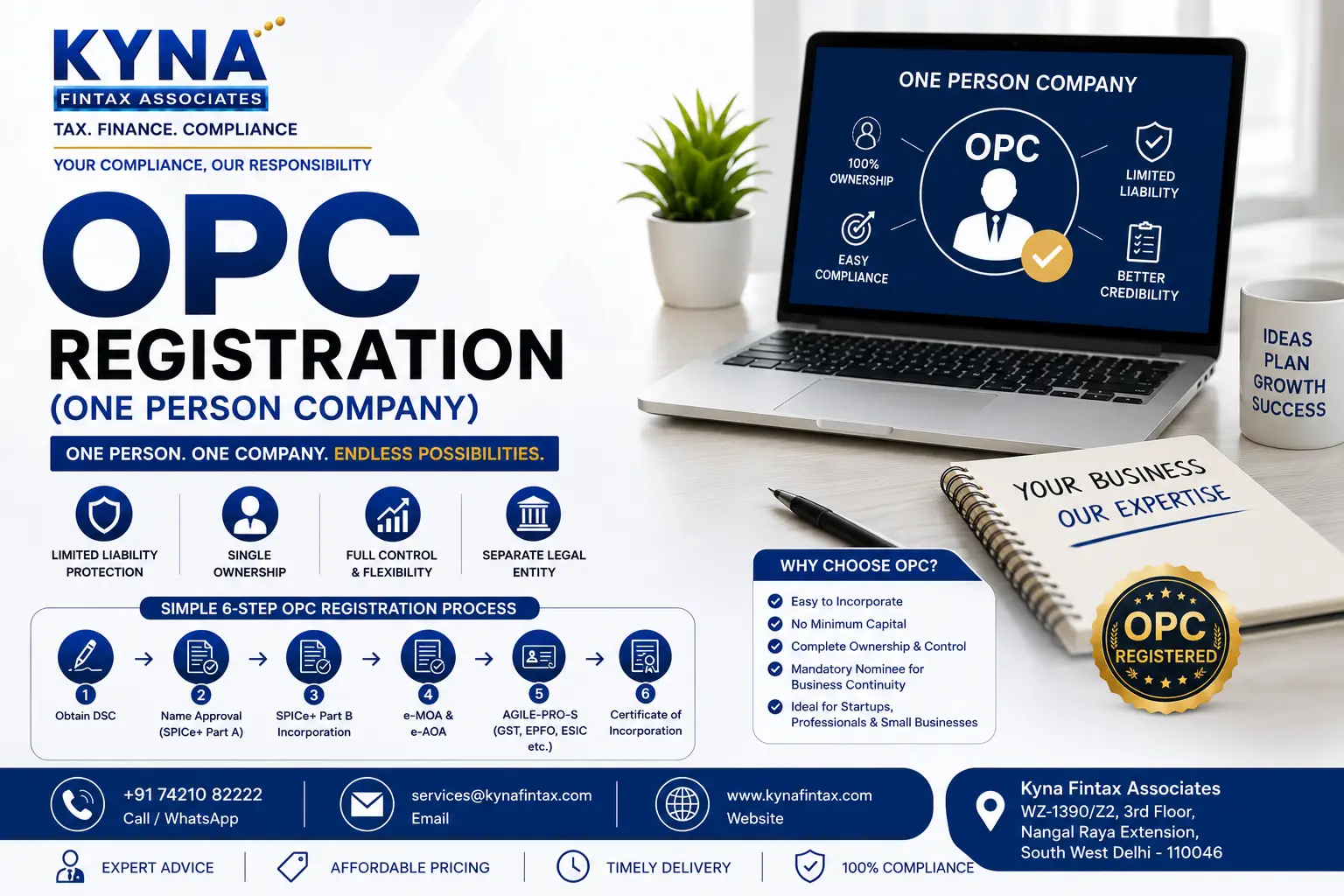
OPC Registration in India – Complete Process, Documents, Fees & Compliance Guide
A One Person Company (OPC) is one of the most beneficial business structures introduced under the Companies Act, 2013 for solo entrepreneurs who want the advantages of a Private Limited Company with complete ownership control.
OPC Registration is ideal for freelancers, consultants, small business owners, startups, and professionals who want limited liability protection, separate legal identity, and better business credibility without involving multiple shareholders.
An OPC combines the benefits of a sole proprietorship and a company structure, making it a preferred choice for individual entrepreneurs looking for professional growth and legal protection.
This detailed guide explains the complete process of OPC Registration in India, including eligibility criteria, required documents, incorporation procedure, benefits, compliance requirements, and important legal aspects.
What is OPC Registration?
A One Person Company (OPC) is a company that can be formed by a single person as both shareholder and director. It is registered under the Companies Act, 2013 and regulated by the Ministry of Corporate Affairs (MCA).
Unlike a sole proprietorship, an OPC is treated as a separate legal entity. This means the company can own property, open bank accounts, enter contracts, and conduct business independently of its owner.
The name of an OPC must end with the words “(OPC) Private Limited”.
Features of One Person Company (OPC)
Single Ownership Structure
Only one shareholder is required to incorporate an OPC.
Separate Legal Entity
The company has a separate legal identity distinct from its owner.
Limited Liability Protection
The personal assets of the owner remain protected against company liabilities.
Perpetual Succession
The company continues even in case of death or incapacity of the owner through a nominee structure.
Better Business Credibility
OPCs generally enjoy higher credibility compared to proprietorship businesses.
Easy Banking & Funding
Banks and financial institutions often prefer registered business entities over unregistered businesses.
Eligibility Criteria for OPC Registration
Before applying for OPC Registration in India, the following conditions must be fulfilled:
| Requirement | Eligibility Criteria |
|---|---|
| Minimum Shareholder | 1 Person |
| Minimum Director | 1 Director |
| Nominee Requirement | Mandatory |
| Resident Director | Must be Indian Resident |
| Maximum Directors | 15 Directors |
| Minimum Capital | No Mandatory Requirement |
| Name Suffix | “(OPC) Private Limited” |
The member and nominee must be natural persons and Indian citizens. Foreign citizens are currently not eligible to form an OPC in India.
Documents Required for OPC Registration
Documents of Director & Shareholder
PAN Card
Self-attested PAN Card copy is mandatory.
Identity Proof
Any one of the following documents can be submitted:
- Aadhaar Card
- Passport
- Driving License
- Voter ID
Address Proof
The address proof should not be older than 2 months.
Accepted documents include:
- Bank Statement
- Electricity Bill
- Mobile Bill
- Telephone Bill
Passport Size Photograph
Recent passport-size photograph of the director/shareholder is required.
Registered Office Address Proof
The company must provide proof of its registered office address.
Required documents include:
- Electricity Bill or Utility Bill
- Rent Agreement (if rented)
- No Objection Certificate (NOC)
- Property Tax Receipt (if applicable)
Step-by-Step Process for OPC Registration in India
The complete incorporation process is conducted online through the MCA portal using SPICe+ forms.
Step 1 – Obtain Digital Signature Certificate (DSC)
The proposed director must obtain a valid Class 3 Digital Signature Certificate (DSC) for signing electronic incorporation documents.
Step 2 – Apply for Company Name Approval
The company name is applied through SPICe+ Part A.
The proposed name must:
- Be unique
- Not resemble existing companies or trademarks
- End with “(OPC) Private Limited”
Applicants can submit two names in order of preference.
Step 3 – File SPICe+ Part B Incorporation Form
Once the company name is approved, SPICe+ Part B is filed.
This integrated form includes:
- DIN allotment
- Registered office details
- Share capital details
- PAN and TAN application
- Nominee details
Step 4 – Draft e-MOA & e-AOA
e-MOA (INC-33)
Defines the company’s business objectives and operational scope.
e-AOA (INC-34)
Contains the internal management rules and operational guidelines.
These forms are digitally signed using DSC.
Step 5 – File AGILE-PRO-S Form
AGILE-PRO-S enables registration for:
- GST Registration
- EPFO Registration
- ESIC Registration
- Professional Tax Registration
- Bank Account Opening
GST registration remains optional depending on business requirements.
Step 6 – Certificate of Incorporation Issued by ROC
After successful verification, the Registrar of Companies (ROC) issues:
- Certificate of Incorporation (COI)
- Corporate Identification Number (CIN)
- PAN
- TAN
Once issued, the OPC becomes a legally registered corporate entity.
Post Incorporation Compliance for OPC
After OPC Registration, certain mandatory legal compliances must be completed.
Opening Current Bank Account
The company must open a current account in its registered name.
Deposit of Capital
The shareholder must deposit the subscribed capital into the company bank account.
Filing INC-20A
The company must file Form INC-20A within 180 days of incorporation for commencement of business.
Appointment of Auditor
The first statutory auditor must be appointed within 30 days of incorporation.
Annual ROC Filing
Every OPC must file annual returns and financial statements with ROC.
Advantages of OPC Registration
Limited Liability Protection
Personal assets remain protected against company liabilities.
Complete Business Control
A single owner has full decision-making authority.
Separate Legal Identity
The company operates independently from its owner.
Better Market Reputation
OPCs generally enjoy greater trust among clients and financial institutions.
Perpetual Succession
The nominee mechanism ensures business continuity.
Suitable for Small Businesses & Startups
OPCs are highly suitable for individual entrepreneurs and professionals.
Disadvantages of OPC Registration
Only One Shareholder Allowed
An OPC cannot have multiple shareholders.
Conversion Requirement
In certain situations, OPC may need conversion into Private Limited Company.
Higher Compliance than Proprietorship
Annual ROC filing and audit requirements apply.
Funding Limitations
Large investors generally prefer Private Limited Companies.
OPC vs Sole Proprietorship
| Basis | OPC | Sole Proprietorship |
|---|---|---|
| Legal Status | Separate Legal Entity | No Separate Identity |
| Liability | Limited | Unlimited |
| Registration | Mandatory | Optional |
| Compliance | Moderate | Minimal |
| Business Credibility | Higher | Lower |
| Funding Scope | Better | Limited |
Who Should Choose OPC Registration?
OPC Registration is ideal for:
- Freelancers
- Consultants
- YouTubers & Influencers
- Small Traders
- Online Businesses
- IT Professionals
- Startup Founders
- Solo Entrepreneurs
Common Mistakes During OPC Registration
Choosing Invalid Company Name
Applications may get rejected due to name similarity or trademark conflicts.
Incorrect Documentation
Mismatched details can delay approval.
Ignoring Post Incorporation Compliance
Failure to file INC-20A or ROC returns may attract penalties.
Improper Nominee Selection
Nominee details must be carefully verified before filing.
Why Professional Assistance is Important for OPC Registration
Professional consultants help with:
- Company name approval
- Correct documentation
- ROC filing
- Compliance management
- GST registration
- Faster incorporation process
Professional assistance reduces rejection chances and ensures smooth registration.
OPC Registration Fees in India
The cost of OPC Registration depends on:
- Government Fees
- DSC Charges
- Stamp Duty
- Professional Fees
- Authorized Capital
The overall registration cost may vary depending on state and business requirements.
Conclusion
An OPC Registration is one of the best business structures for solo entrepreneurs seeking legal protection, professional identity, and business credibility.
With advantages like limited liability, separate legal entity status, perpetual succession, and complete ownership control, OPC offers a perfect balance between flexibility and legal recognition.
Entrepreneurs planning long-term business growth should strongly consider registering an OPC under the Companies Act, 2013.
Frequently Asked Questions (FAQs)
How many persons are required for OPC Registration?
Only one person is required.
Is nominee mandatory in OPC?
Yes, appointment of nominee is mandatory.
Can OPC have multiple directors?
Yes, an OPC can appoint up to 15 directors.
Is GST registration mandatory for OPC?
GST registration depends on turnover and business activity.
How long does OPC Registration take?
Generally, OPC incorporation takes around 7–15 working days.
Can OPC raise funding from investors?
Funding options are limited compared to Private Limited Companies.
Is audit mandatory for OPC?
Yes, statutory audit requirements apply.
Kyna FinTax LLP provides professional assistance for OPC Registration, company incorporation, GST registration, ROC compliance, taxation, startup advisory, and legal compliance services across India.
Contact Details:
Kyna FinTax LLP
WZ-1390/Z2, 3rd Floor, Nangal Raya Extension, South West Delhi – 110046
📞 WhatsApp/Call: +91 74210 82222
📧 services@kynafintax.com
🌐 https://kynafintax.com
For official corporate filing updates, visit the MCA Portal