
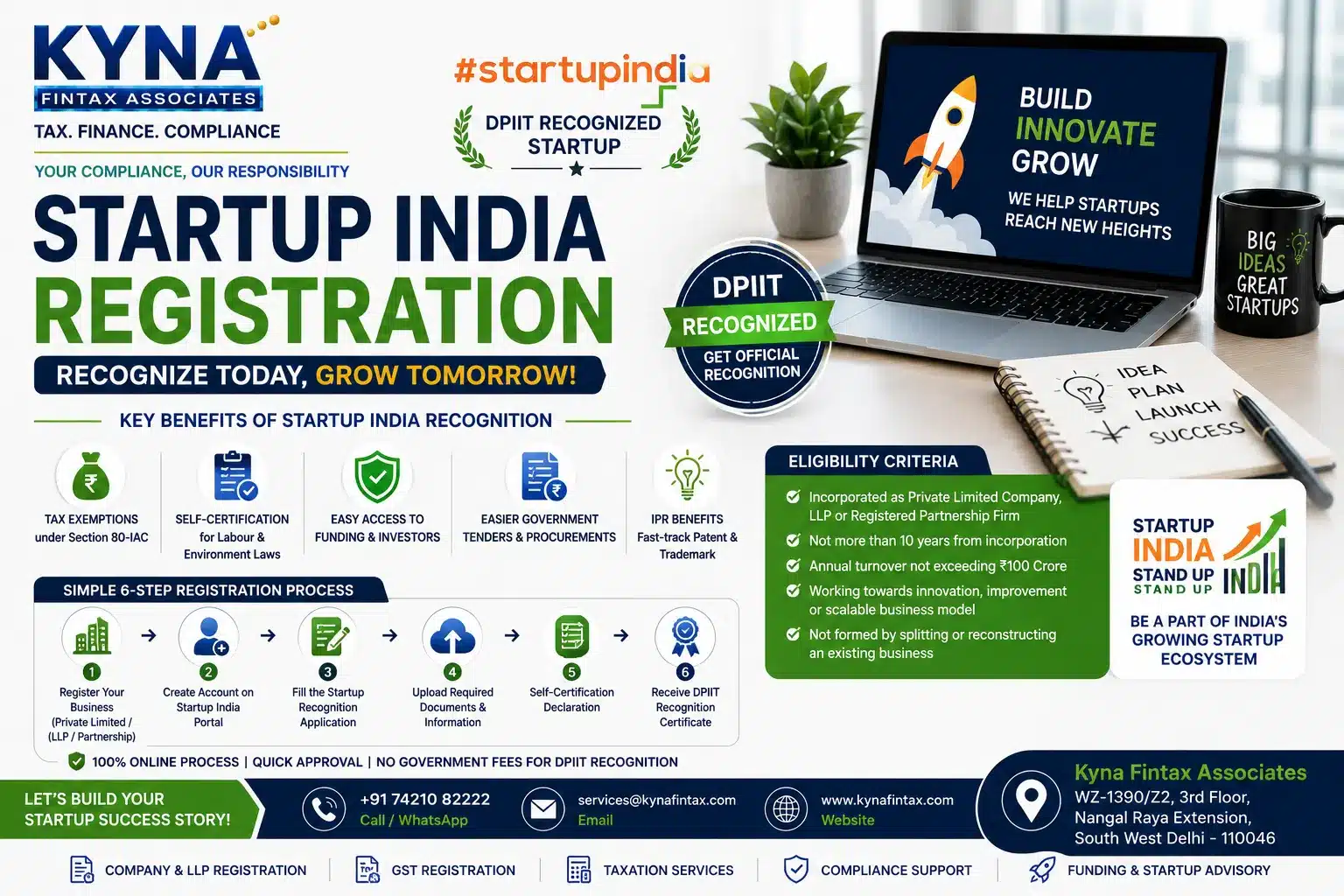
Startup India Registration – Complete Process, Eligibility, Benefits & DPIIT Recognition Guide
Startup India Registration is a government-backed initiative launched by the Government of India to promote innovation, entrepreneurship, employment generation, and startup growth across the country.
Under the Startup India Scheme, eligible startups can obtain DPIIT Recognition from the Department for Promotion of Industry and Internal Trade (DPIIT), enabling them to access tax benefits, easier compliance, funding support, intellectual property benefits, government tenders, and various startup incentives.
The Startup India initiative is especially beneficial for technology startups, innovative businesses, scalable ventures, and new-age entrepreneurs seeking legal recognition and growth opportunities.
This comprehensive guide explains the complete process of Startup India Registration, including eligibility criteria, required documents, benefits, registration procedure, DPIIT recognition, tax exemptions, and compliance requirements.
What is Startup India Registration?
Startup India Registration refers to obtaining official recognition from DPIIT under the Startup India Scheme introduced by the Government of India.
A business recognized under Startup India gains access to multiple government benefits including:
- Tax exemptions
- Funding opportunities
- Self-certification compliance
- Easier public procurement norms
- Fast-track patent registration
- Networking opportunities
The registration is completed online through the official Startup India portal.
What is DPIIT Recognition?
DPIIT Recognition is the official recognition granted to eligible startups by the Department for Promotion of Industry and Internal Trade.
Once approved, the startup receives a DPIIT Recognition Certificate and unique Startup India recognition number.
This recognition acts as proof that the business qualifies as an eligible startup under government guidelines.
Eligibility Criteria for Startup India Registration
To obtain Startup India Recognition, the business must fulfill the following conditions:
| Eligibility Criteria | Requirement |
|---|---|
| Business Structure | Private Limited Company, LLP, or Registered Partnership Firm |
| Business Age | Not more than 10 years from incorporation |
| Annual Turnover | Not exceeding ₹100 Crores in any financial year |
| Innovation Requirement | Business must work towards innovation, development, improvement, or scalable business model |
| Original Entity | Should not be formed by splitting or reconstructing an existing business |
Sole Proprietorship businesses are not eligible for Startup India Registration.
Eligible Business Structures for Startup India
The following business entities are eligible:
- Private Limited Company
- Limited Liability Partnership (LLP)
- Registered Partnership Firm
Businesses must be legally registered before applying for Startup India Recognition.
Documents Required for Startup India Registration
Business Registration Documents
The applicant must provide incorporation documents such as:
- Certificate of Incorporation
- LLP Incorporation Certificate
- Partnership Registration Certificate
PAN Card of Business
Business PAN details are mandatory.
Director/Partner Details
Identity proof and details of directors or partners may be required.
Business Description
A detailed write-up explaining:
- Nature of business
- Innovation aspect
- Scalability
- Problem-solving capability
- Business model
Website or Pitch Deck (Optional but Recommended)
Supporting documents like:
- Startup pitch deck
- Website link
- Product presentation
- Funding details
may strengthen the application.
Step-by-Step Process for Startup India Registration
Step 1 – Register Your Business Entity
Before applying for Startup India Recognition, the business must first be registered as:
- Private Limited Company
- LLP
- Registered Partnership Firm
Step 2 – Create Account on Startup India Portal
Visit the official Startup India portal and create a startup profile.
Step 3 – Apply for DPIIT Recognition
Fill the Startup Recognition Form with details such as:
- Business type
- Industry
- Incorporation details
- Startup activities
- Innovation details
- Funding information
Step 4 – Upload Required Documents
Upload all necessary documents and supporting information.
Step 5 – Self Certification Declaration
The applicant must certify that the startup fulfills all eligibility conditions prescribed by DPIIT.
Step 6 – Receive DPIIT Recognition Certificate
Upon successful verification, the DPIIT Recognition Certificate is issued online.
Benefits of Startup India Registration
Tax Exemption Benefits
Eligible startups may claim income tax exemption under Section 80-IAC for 3 consecutive financial years subject to conditions.
Easy Compliance
Startups can self-certify compliance under certain labour and environmental laws.
Fast-Track Patent & Trademark Registration
Recognized startups receive:
- Reduced government fees
- Fast-track IP processing
- Facilitator support for patents and trademarks
Easier Access to Government Tenders
Startup-recognized entities get exemptions from prior turnover and experience requirements in many government tenders.
Funding Support
Eligible startups may access:
- Government funding schemes
- SIDBI support
- Investor networks
- Incubation programs
Networking & Mentorship Opportunities
The Startup India ecosystem offers exposure to:
- Investors
- Incubators
- Accelerators
- Government programs
- Industry mentors
Startup India Tax Exemption under Section 80-IAC
Recognized startups may apply for tax exemption under Section 80-IAC of the Income Tax Act.
Conditions include:
- DPIIT Recognition
- Eligible business activities
- Inter-Ministerial Board approval (where applicable)
The exemption allows startups to claim 100% deduction on profits for 3 consecutive years out of 10 years from incorporation.
Startup India Registration for Private Limited Company
Private Limited Companies are the most preferred business structure for startups because they offer:
- Investor-friendly structure
- Equity funding capability
- Better scalability
- Separate legal identity
Most venture capitalists and angel investors prefer Private Limited Companies.
Startup India Registration for LLP
LLPs can also obtain Startup India Recognition if they satisfy innovation and scalability conditions.
LLPs are preferred for:
- Professional startups
- Service-based businesses
- Low-compliance operations
Common Mistakes During Startup India Registration
Weak Business Description
Poorly written innovation explanations often lead to rejection.
Applying Without Proper Business Registration
Only eligible registered entities can apply.
Lack of Innovation Element
Traditional businesses without innovation or scalability may not qualify.
Incorrect Documentation
Mismatched or incomplete documents can delay approval.
Why Professional Assistance is Important?
Professional consultants help startups with:
- Company or LLP incorporation
- DPIIT Recognition application
- Tax exemption advisory
- Startup compliance
- Trademark & IP filing
- Funding documentation
Expert assistance improves approval chances and ensures smooth compliance management.
Startup India Registration Fees
Government filing for DPIIT Recognition is generally free.
However, costs may apply for:
- Company/LLP registration
- Professional fees
- Trademark registration
- Compliance support
- Startup advisory services
Who Should Apply for Startup India Registration?
Startup India Recognition is ideal for:
- Tech Startups
- SaaS Companies
- E-commerce Startups
- FinTech Businesses
- HealthTech Startups
- EdTech Companies
- AI & Innovation Startups
- Scalable Digital Businesses
Startup India Registration provides a powerful platform for innovative businesses to access government recognition, tax benefits, funding opportunities, legal support, and startup ecosystem advantages.
With benefits like DPIIT Recognition, tax exemptions, easier compliance, intellectual property support, and startup funding opportunities, Startup India plays a major role in supporting entrepreneurship and innovation in India.
Businesses aiming for scalable growth, investor funding, and startup ecosystem benefits should strongly consider obtaining Startup India Recognition.
Frequently Asked Questions (FAQs)
Is Startup India Registration mandatory?
No, but it is highly beneficial for eligible startups seeking government benefits and recognition.
Who provides Startup India Recognition?
DPIIT (Department for Promotion of Industry and Internal Trade) provides recognition.
Can Sole Proprietorship apply for Startup India?
No, Sole Proprietorship businesses are not eligible.
Is there any government fee for DPIIT Registration?
Generally, there is no government fee for DPIIT Recognition application.
How long does Startup India Registration take?
Usually, DPIIT Recognition is granted within a few working days if documents are correct.
Can existing businesses apply for Startup India?
Yes, if the business is less than 10 years old and fulfills eligibility conditions.
Is tax exemption automatic after Startup India Registration?
No, separate conditions and approvals may apply for tax exemption benefits.
Kyna FinTax LLP
Kyna FinTax LLP provides professional assistance for Startup India Registration, DPIIT Recognition, Private Limited Company registration, LLP registration, GST registration, startup compliance, tax advisory, trademark filing, and business incorporation services across India.
Contact Details:
Kyna FinTax LLP
WZ-1390/Z2, 3rd Floor, Nangal Raya Extension, South West Delhi – 110046
📞 WhatsApp/Call: +91 74210 82222
📧 Email: services@kynafintax.com
🌐 Website: https://kynafintax.com
For official DPIIT recognition and startup ecosystem updates, visit the Startup India Portal