
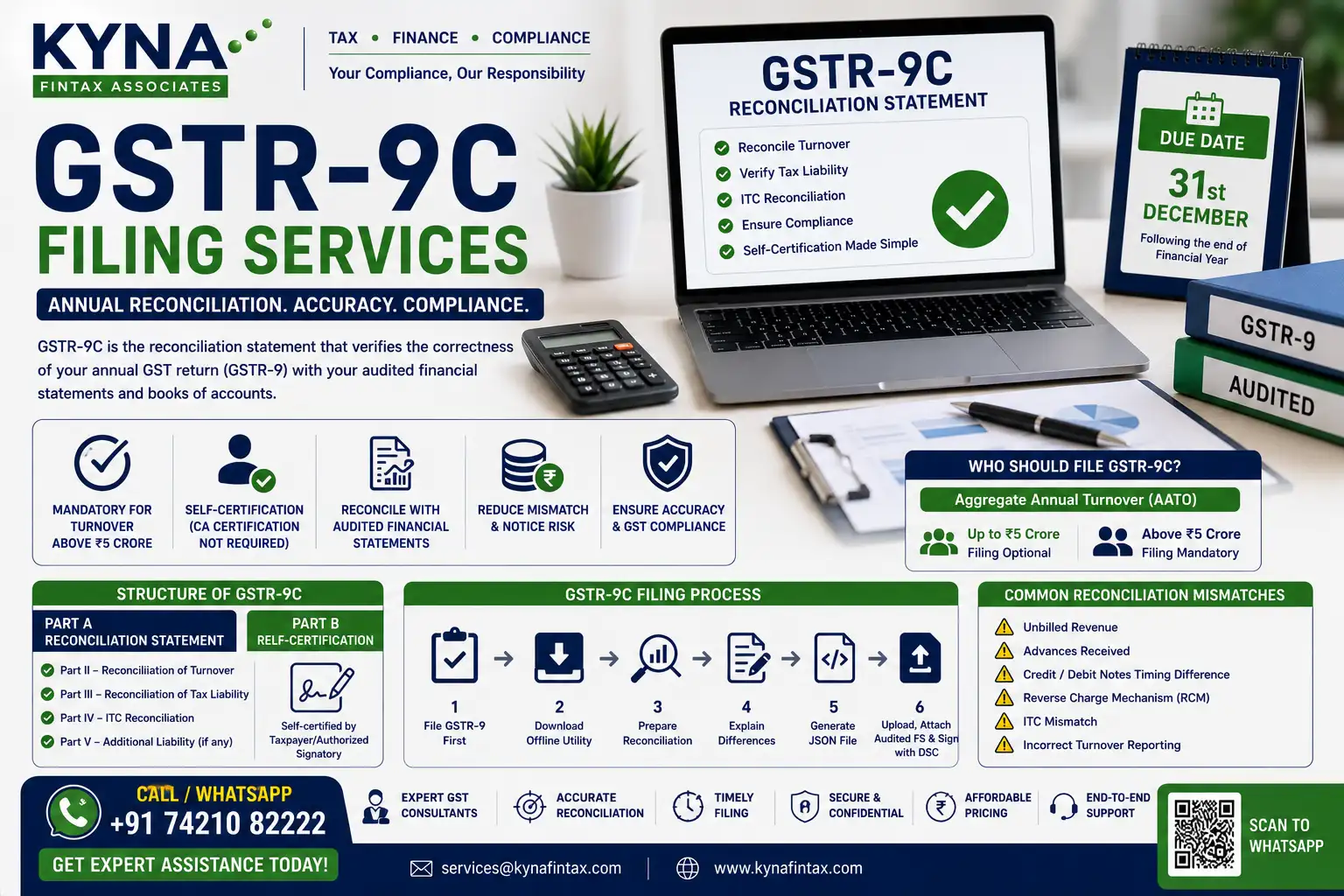
GSTR-9C Filing Services in Delhi
Filing annual GST returns can be one of the most stressful compliance tasks for businesses, especially when turnover crosses the prescribed threshold under GST law. If your business falls under the mandatory applicability criteria, GSTR-9C Filing becomes a critical part of your annual GST compliance process.
Kyna FinTax LLP provides professional GSTR-9C Filing Services in Delhi for private limited companies, LLPs, partnership firms, manufacturers, traders, wholesalers, service providers, e-commerce businesses, startups, and large taxpayers across Delhi and India.
Our expert GST consultants assist businesses with:
- GSTR-9C Filing
- GST Reconciliation
- Turnover Verification
- Input Tax Credit (ITC) Reconciliation
- GST Annual Compliance
- GST Audit Support
- GSTR-9 Filing
- GST Notice Support
- GST Mismatch Resolution
- GST Annual Return Review
We provide GST reconciliation and GSTR-9C filing services across:
- Dwarka
- Janakpuri
- Uttam Nagar
- Palam
- Tilak Nagar
- Hari Nagar
- Rajouri Garden
- Subhash Nagar
- Mayapuri
- Naraina
- Kirti Nagar
- Rohini
- NSP
- Pitampura
- Punjabi Bagh
- Paschim Vihar
- Patel Nagar
- Karol Bagh
- Connaught Place
- Laxmi Nagar
- Shahdara
- Preet Vihar
- Okhla
- Bawana
- Narela
- West Delhi
- South Delhi
- North Delhi
- South West Delhi
If you are searching for:
- GSTR-9C filing services
- GST reconciliation statement filing
- annual GST reconciliation services
- online GSTR-9C filing
- GSTR-9C consultant in Delhi
- GST annual compliance services
- GST audit support
- GST consultant near me
Kyna FinTax LLP provides complete professional assistance.
What is GSTR-9C?
GSTR-9C is a GST reconciliation statement that acts as a bridge between:
- GSTR-9 Annual Return
- Audited Financial Statements
The main purpose of GSTR-9C is to ensure that the turnover and tax reported in GST returns match the books of accounts and audited financial statements of the business.
If there are discrepancies or mismatches between:
- GST returns
- books of accounts
- audited balance sheet
- profit & loss account
they must generally be reconciled and properly disclosed in GSTR-9C.
Why is GSTR-9C Filed?
GSTR-9C is generally filed to:
- reconcile GST turnover with books
- verify annual tax liability
- reconcile Input Tax Credit (ITC)
- identify GST mismatches
- maintain annual GST compliance
- improve financial transparency
- reduce GST scrutiny risk
- avoid future notices and penalties
Proper reconciliation helps businesses maintain accurate GST records and avoid future compliance issues.
GSTR-9C Filing Limit & Applicability
The requirement to file GSTR-9C generally depends on Aggregate Annual Turnover (AATO).
Turnover Up to ₹5 Crore
For eligible businesses having aggregate annual turnover up to ₹5 crore, GSTR-9C filing has generally been optional under applicable GST notifications.
However, such businesses may still require:
- GSTR-9 Annual Return filing
- annual GST reconciliation
- GST compliance review
depending on turnover and applicable provisions.
Turnover Above ₹5 Crore
Businesses with aggregate annual turnover above ₹5 crore may generally require mandatory:
- GSTR-9 filing
- GSTR-9C filing
- annual GST reconciliation compliance
under applicable GST provisions.
Important Update for GSTR-9C
Since FY 2020-21, the requirement for Chartered Accountant (CA) or CMA certification in GSTR-9C has generally been removed.
Eligible taxpayers may now generally self-certify the reconciliation statement under applicable GST provisions.
Due Date for GSTR-9C Filing
Standard Due Date
The standard due date for GSTR-9C filing is generally:
31st December
following the end of the relevant financial year unless extended through government notifications.
Example:
For FY 2025-26, the due date may generally be 31st December 2026 unless extended.
Important Prerequisite Before Filing GSTR-9C
GSTR-9C filing generally requires prior filing of:
- GSTR-9 Annual Return
The GST portal may generally not allow GSTR-9C filing unless GSTR-9 has already been filed.
Structure of GSTR-9C
GSTR-9C is generally divided into two major parts.
Part A – Reconciliation Statement
This section generally covers:
- turnover reconciliation
- tax liability reconciliation
- Input Tax Credit reconciliation
- annual GST adjustments
- reconciliation mismatch details
Part II – Reconciliation of Turnover
This section generally reconciles:
- turnover as per books
- turnover as per GST returns
Part III – Tax Liability Reconciliation
This section generally reconciles:
- GST tax rates
- tax payable
- tax paid
under different GST slabs such as:
- 5%
- 12%
- 18%
- 28%
- 40%
Part IV – ITC Reconciliation
This section generally reconciles:
- ITC as per books
- ITC claimed in GST returns
- ITC mismatch details
Part V – Additional Liability
This section generally covers additional tax liability identified during reconciliation.
Part B – Self-Certification
This section generally includes:
- taxpayer declaration
- authorized signatory verification
- digital signature compliance
Common Reasons for GSTR-9C Mismatch
GST reconciliation mismatch may generally arise due to:
- unbilled revenue
- GST advances
- credit note timing difference
- debit note mismatch
- Reverse Charge Mechanism (RCM) liability
- ITC mismatch
- incorrect turnover reporting
- accounting errors
- reconciliation differences
Documents Required for GSTR-9C Filing
Common Documents Required
- GST Login Credentials
- GSTR-1 Returns
- GSTR-3B Returns
- GSTR-9 Annual Return
- Audited Financial Statements
- Balance Sheet
- Profit & Loss Account
- Trial Balance
- Sales Register
- Purchase Register
- ITC Details
- GST Reconciliation Reports
- Books of Accounts
Step-by-Step GSTR-9C Filing Process
Step 1 – File GSTR-9 Annual Return
GSTR-9 filing is generally required before filing GSTR-9C.
Step 2 – Download Offline Utility
The GST portal generally provides the GSTR-9C Offline Utility for reconciliation preparation.
Step 3 – Prepare GST Reconciliation
Our experts reconcile:
- books of accounts
- GST turnover
- ITC
- tax liability
- annual returns
Step 4 – Explain Differences
Every unreconciled amount is properly analyzed and disclosed with supporting explanations.
Step 5 – Generate JSON File
Validated reconciliation data is converted into JSON format through the utility.
Step 6 – Upload & File GSTR-9C
The reconciliation statement and supporting documents are uploaded through the GST portal using DSC or applicable verification methods.
Important Tips Before Filing GSTR-9C
Reconcile GSTR-1 & GSTR-3B Early
Businesses should reconcile:
- GSTR-1
- GSTR-3B
- books of accounts
- annual turnover
before preparing GSTR-9C.
Verify HSN Summary
Accurate HSN reporting is important because tax authorities increasingly review:
- HSN mismatch
- incorrect tax rate classification
- GST turnover inconsistency
Verify ITC Properly
Incorrect ITC reporting may lead to:
- GST notices
- ITC reversals
- reconciliation mismatch
- scrutiny proceedings
Review System Computed Data
Businesses should compare GST portal data with accounting software and books before filing.
Penalty & Compliance Risk
Incorrect or delayed GSTR-9C filing may generally lead to:
- GST notices
- compliance scrutiny
- reconciliation disputes
- penalty exposure
- departmental queries
Proper annual GST reconciliation helps businesses maintain compliance and reduce litigation risk.
Benefits of Professional GSTR-9C Filing Services
Professional GST assistance helps businesses:
- improve reconciliation accuracy
- maintain annual GST compliance
- reduce mismatch risk
- verify turnover properly
- improve ITC reconciliation
- avoid notices and scrutiny
- maintain financial transparency
Why Choose Kyna FinTax LLP?
Kyna FinTax LLP provides professional GSTR-9C filing services in Delhi with complete GST reconciliation and annual compliance support.
Our Strengths
- Experienced GST Consultants
- GST Reconciliation Expertise
- Annual GST Compliance Support
- Fast Filing Process
- Affordable Pricing
- WhatsApp Assistance
- Delhi-Based Professional Team
- Secure Documentation Process
Frequently Asked Questions (FAQs)
Is GSTR-9C mandatory?
Applicability may generally depend on aggregate annual turnover and applicable GST provisions.
What is the purpose of GSTR-9C?
GSTR-9C helps reconcile GST returns with audited financial statements and books of accounts.
Is CA certification mandatory for GSTR-9C?
Eligible taxpayers may generally self-certify GSTR-9C under applicable GST provisions.
Can GSTR-9C be filed without GSTR-9?
Generally, GSTR-9 filing is required before filing GSTR-9C.
Why is GST reconciliation important?
Proper reconciliation helps reduce:
- GST mismatch
- ITC issues
- annual reporting errors
- compliance risks
- GST notices
Related Services
- GSTR-9 Annual Return Filing
- GSTR-3B Filing Services
- GSTR-1 Filing Services
- GST Audit Support
- GST Reconciliation Services
- GST Notice Support
Get Professional Help for GSTR-9C Filing in Delhi
Looking for reliable GSTR-9C filing services in Delhi? Contact Kyna FinTax LLP for fast and hassle-free GST reconciliation and annual compliance support.
Kyna FinTax LLP
WZ-1390/Z2, 3rd Floor, Nangal Raya Extension, South West Delhi – 110046
Phone / WhatsApp: +91 74210 82222
Email: services@kynafintax.com
Website: https://kynafintax.com
For GST registration and return updates, visit GST Portal.